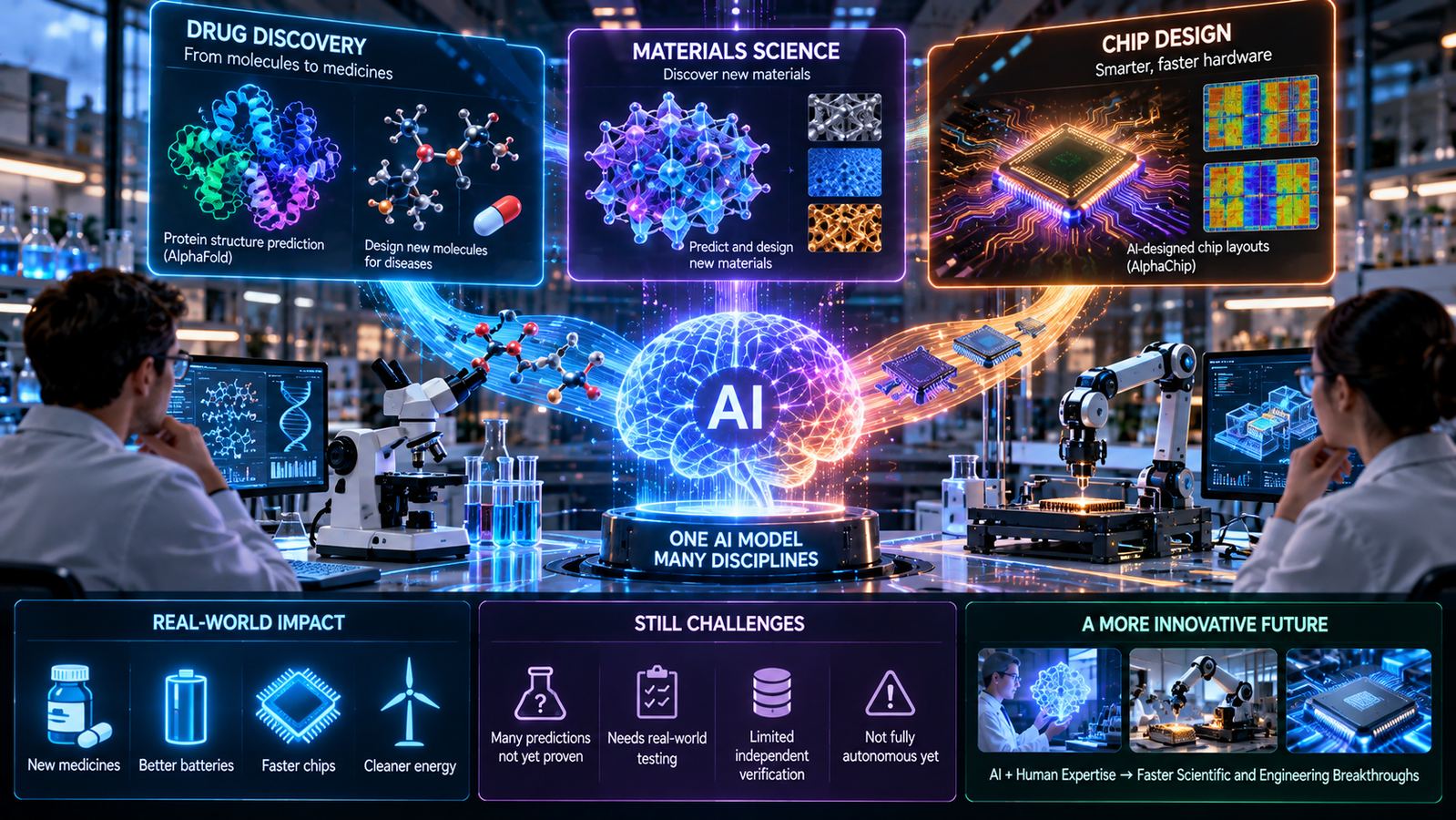
Scientists and engineers spend a lot of time searching through huge piles of options. Millions of possible molecules. Thousands of chip layouts. Endless small design changes. Now AI is doing some of that searching. Google DeepMind, its drug spin-off Isomorphic Labs, OpenAI, Anthropic, and many university labs are building AI that can predict structures, suggest ideas, and help design parts.
Some of this already works. Some of it is still just a big claim. The difference matters, because the payoff is real: new medicines, better batteries, and faster chips.
What Already Works
The clearest success is AlphaFold. It predicts the 3D shape of a protein from its chemical makeup. Biologists had tried to solve this for about 50 years. AlphaFold's creators shared the 2024 Nobel Prize in Chemistry. DeepMind and its partner EMBL-EBI say more than three million people in over 190 countries have used its free database of predictions. This is a working tool, backed by years of use in real labs.
Engineering has a similar example. Google says AlphaChip helped lay out every generation of its TPU chips since 2020. It learns to place chip parts the way a game player learns moves. MediaTek has used it too. But it is not fully settled. Critics say outside teams could not repeat the gains. Google disagrees. Nature reviewed the paper a second time and published an addendum instead of a correction. The chip designs are private, so nobody can run a fully open test.
Big Claims, Thin Proof
GNoME is a different story. This DeepMind system predicted 2.2 million new crystal structures in 2023. About 380,000 of them were predicted to be stable. Chemists Anthony Cheetham and Ram Seshadri at UC Santa Barbara checked a sample. They found little evidence for compounds that were new, believable, and useful at the same time. A 2026 preprint says a re-check of a related robot-lab claim found that none of the results were convincingly shown. The lesson is simple. A computer saying a material could exist is not the same as making one that works.
AI Scientists: Prototypes and Promises
Google's AI co-scientist was published in Nature in 2026. It uses several Gemini-based AI agents that suggest ideas, argue about them, and rank them. Researchers have tried it on problems like fibrosis and antibiotic resistance. So far, the results are lab tests, not treatments.
Isomorphic Labs announced a private drug-design model in February 2026. A Columbia computational biologist called it "a major advance, on the scale of an AlphaFold 4." But the technical report is thin, and outside scientists cannot use the model. Its first human trials were delayed from 2025 and are now expected by the end of 2026. Until then, it is a promising prototype.
OpenAI said on September 6 that it had built an "automated research intern." It can do well-defined research tasks under human direction, including work that would take a skilled researcher a few days. Note what this covers. It is AI research inside OpenAI, done mostly by coding agents. It is not lab science. Also, OpenAI set the goal, wrote the definition, and did the measuring itself. Its own post admits that over half of the successful four-to-eight-hour tasks still needed a human to step in. OpenAI also says it does not yet know how to safely reach its next goal: a fully automated researcher by March 2028.
Why Some Fields Move Faster
AI moves fastest where answers can be checked automatically. Google's AlphaEvolve works this way. Gemini comes up with ideas, and automated checkers test each one. The best ideas get improved again. Google says it sped up one key step in Gemini by 23%, which cut training time by about 1%. That number comes from Google. Still, the automatic checker makes it hard to cheat.
Physical work is harder. One survey found that no AI agent has yet finished a full industrial chip design without human help. And a faster model cannot rush a lab experiment or a clinical trial.
What Could Come Next
In the near term, expect AI to show up more inside the tools scientists and engineers already use. Also expect the first real test of AI-designed drugs in human trials. The bigger change may be where the bottleneck sits. If AI can suggest millions of ideas cheaply, the hard part becomes testing them and knowing which claims to trust.
The long-term story is still a prediction. Demis Hassabis says we could enter a new golden era of discovery in 10 to 15 years. That is a forecast, not a result. What we can say today is smaller, but more useful. AI is already a strong helper on problems where results can be checked. On everything else, it still has to prove itself.