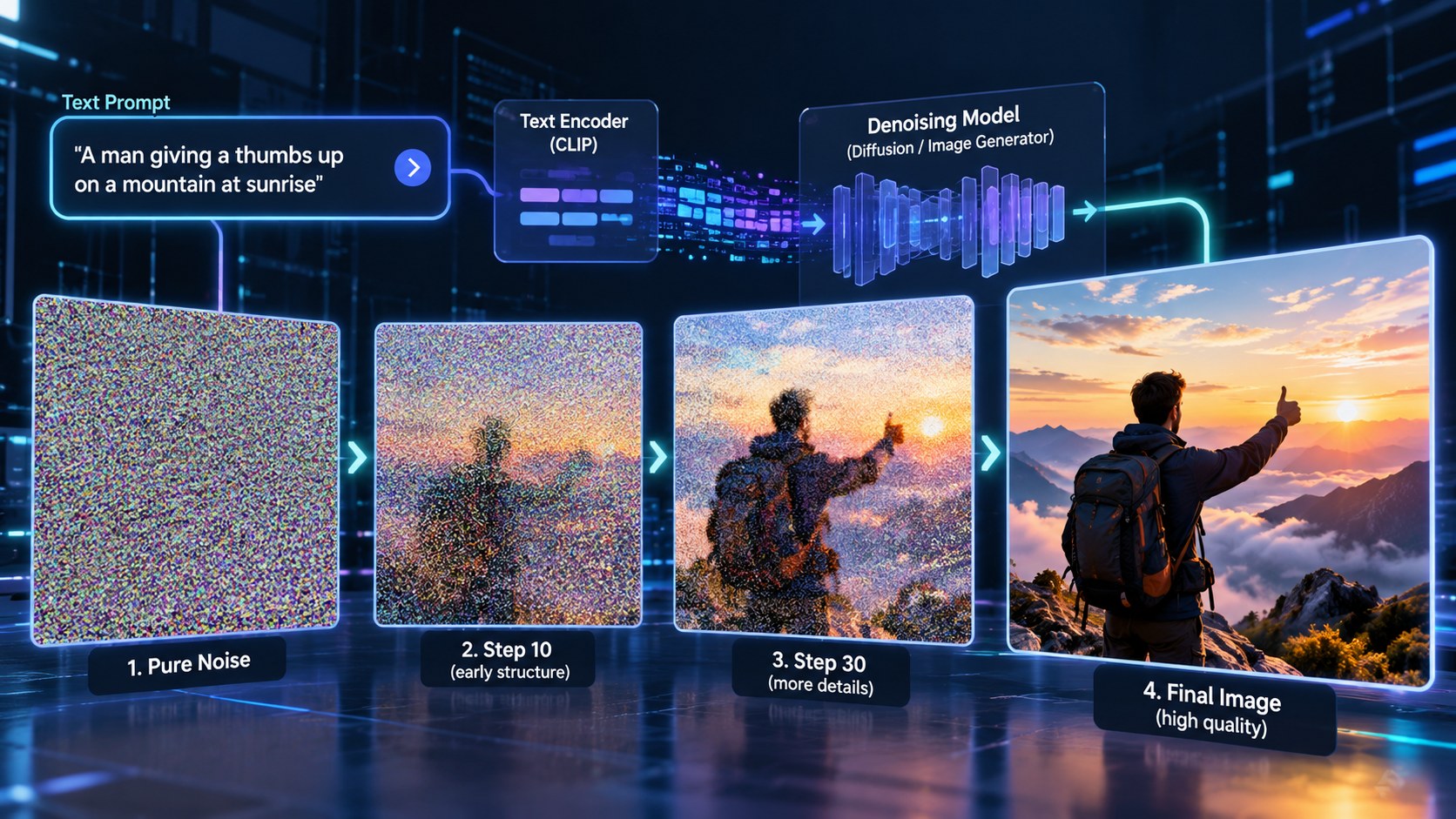
Ask an AI image generator for “a man giving a thumbs up,” and there’s a good chance he’ll have six fingers. Ask for a street sign, and the words on it might be confident nonsense. Yet the same tool can paint a photorealistic dragon on a mountain, in a style no one has ever drawn before. That’s strange, until you understand what these systems actually do. It’s nothing like painting.
They start with pure noise. Then, step by step, they clean it up into a picture.
What your prompt actually does
When you type a prompt, the model doesn’t read it the way you do. A text encoder — often a system called CLIP — turns your words into a long list of numbers. Think of it as a fingerprint of what you asked for. The model checks this fingerprint at every step of the image-making process, so the picture keeps moving toward what you typed.
How diffusion works: static, slowly cleaned up
Here’s the part most people get backwards. To train the model, researchers took real photos and slowly buried them in random noise. Step by step, they added more noise until nothing recognisable was left — just fuzzy static, like an old TV with bad reception. Then they trained the model to undo this. Given a noisy image, it learned to guess what a slightly cleaner version would look like.
To make a new image, the model runs that skill in reverse. It starts with pure noise and cleans it up bit by bit, guided by your prompt’s fingerprint at every step. After a few dozen steps, the noise turns into a picture. Most modern systems don’t work on every single pixel. Instead, they work on a smaller, simplified version of the image. That’s a big reason why generating an image now takes seconds instead of minutes.
It learned all of this from an enormous pile of pictures
None of this works without training data. Models learn from hundreds of millions, even billions, of image-and-caption pairs, mostly scraped from the internet. Each pair teaches the model a tiny piece of what words tend to look like. This is also where its weaknesses come from. If a pattern shows up often and clearly in the data, the model gets good at it. If a pattern is rare, or the captions describe it badly, the model never really learns it — it just makes its best guess.
Why hands are the tell
A human hand has 27 bones and can bend in countless ways. In ordinary photos, hands are often half-hidden too — holding a cup, tucked in a pocket, or blurred mid-gesture. Captions rarely describe hand position in detail. A photo gets labelled “man drinking coffee,” never “three fingers around the mug, thumb visible, pinky raised.” So the model ends up with a rough, blurry idea of what hands generally look like. It never learns the simple rule that a hand has exactly five fingers in one arrangement. That’s why it sometimes blends two half-remembered hand poses into a six-fingered mess.
Text used to be hopeless. Now it depends which model you use.
Text used to be the clearest sign that an image was AI-made. A letter is only correct if every stroke lands exactly right. There’s no room for the loose guessing that works fine for a tree or a cloud. Older models treated letters as shapes, not as symbols with one fixed, correct form. So they’d copy the general look of writing without getting the actual words right.
That weakness has genuinely improved. By 2026, newer image-generation systems had introduced improvements specifically aimed at text rendering, and the results were noticeably better than in earlier systems. OpenAI’s GPT Image 2, released on April 21, 2026, includes a “thinking” mode that plans the image before drawing it, and OpenAI highlighted stronger text rendering at launch. OpenAI has not said whether the model uses diffusion or another method. Google’s Gemini image models, including the models marketed under the Nano Banana name, have also improved their ability to render short signs and labels. Ideogram continues to focus specifically on accurate text rendering. These improvements did not come from one general breakthrough. They came from targeted engineering aimed at specific weaknesses, including better training and, in OpenAI’s case, a planning step before the image is generated. This shows that some weaknesses can be reduced through focused engineering, even though they have not been eliminated entirely.
Physics and layout: a harder, different kind of problem
Physics and precise layout haven’t improved the same way. The reason is simple: there’s no physics engine or 3D model of the world running inside these systems. The model has never simulated gravity, or the fact that two solid objects can’t share the same space. It has only seen flat, finished photos of a world where those rules already happened to be followed. So it copies the pattern without understanding the rule behind it. This is also why placing three specific objects in exact positions is much harder than generating a general scene. Getting each object’s identity, size, and position right, all at once, means solving several problems together — something the model was never trained to do as one task.
Text got fixed faster than hands or physics because it’s a narrow, clear target. Better data can go straight at it. Hands and physical realism come from the model’s whole, general sense of what images look like. There’s no single fix for that — just a harder, more open-ended problem.
Why this matters, and where it’s heading
This isn’t just trivia about how a cool tool works. It tells you when to trust these systems, and when to double-check them. For a mood board or general concept art, today’s tools are already good enough that the gap barely matters. But for anything that needs to be exactly right — a diagram with a specific number of parts, a mockup where the text must say something exact, a product photo where an object’s position matters — you’re asking the model to do the one thing it was never built to guarantee. Plan to check the output by hand.
The stakes get higher as these tools move from novelty to everyday use. A wrong number of fingers on a birthday card doesn’t matter much. But the same kind of guessing inside a generated diagram, a safety sign, or a real product photo is a different kind of error. It looks just as confident as the parts the model got right. That’s the real risk with these systems. They don’t fail loudly — they fail quietly, with the same polish as their successes. That makes them harder to spot-check than a rough human sketch, which at least looks unfinished.
The text-rendering fix also hints at where this is heading. It won’t be one breakthrough that solves everything. It’ll be a series of smaller, deliberate fixes for specific weak spots. Researchers are already running the same playbook on layout, using techniques that handle each object in a scene somewhat separately before merging them together. They’re doing the same for hands, using training sets built specifically to teach correct hand structure. None of this adds up to real physical understanding yet. The model still isn’t simulating a world — it’s just getting better at faking one convincingly. But today’s weaknesses aren’t necessarily permanent. They’re a list of problems being solved one at a time, not one single wall.