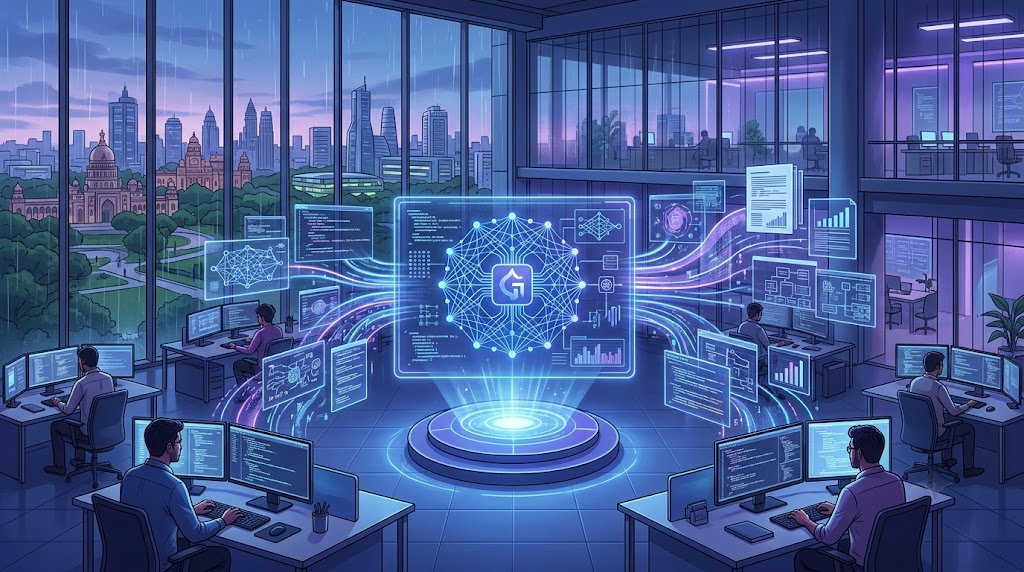
Google has introduced Gemini 4 Argon, the first model in its new Gemini 4 generation. Announced on September 30, the model is aimed at tasks that require more than a short answer, particularly software engineering, professional research and cybersecurity.
Rather than positioning Argon mainly as another chatbot, Google is presenting it as a model for long-running workflows where an AI system may need to analyse information, write code, check its work and continue through several steps.
A Much Larger Output Limit
One of Argon’s most noticeable changes is its 1-million-token maximum output, up from 64,000 tokens in previous Gemini models.
That capacity could be useful when working with large software projects, lengthy technical documents or complicated research tasks. But a larger context or output limit does not automatically make an AI system more accurate. The quality still depends on how well the model reasons, follows instructions and handles mistakes.
Google says its own teams are already using Argon for coding, debugging and optimisation. In one internal project, AI agents helped optimise systems that eventually freed more than 300 TiB of memory across Google's data centres. Google also says its agents are working on the migration of more than 800,000 lines of C and C++ code to Rust, although that work is still going through testing and review.
Coding Is a Major Focus
Software engineering is one of the clearest areas where Google is testing Argon.
Google reports a 77.9% score on DeepSWE v1.1, a benchmark designed around long software-engineering tasks. It also reports 51.3% on AutomationBench and 91.7% on LVBench, a benchmark for long-video understanding. These are Google's reported results, so they should be viewed as benchmark measurements rather than proof that Argon is better at every task.
The model is also being used for large code transformations. Google says one project replaced 32,000 lines of SIMD code in the libgav1 video decoder with Rust, with the resulting decoder running faster than the previous Rust version.
Why Cybersecurity Is Central to the Launch
Cybersecurity is not just another feature of Argon; it is part of Google's initial rollout strategy.
Google is first giving the model to a limited group of trusted cyber defenders through its Fairwind Program. The company says Argon can help security teams find vulnerabilities, validate them and work on fixes. Google is also testing safeguards against misuse, including prompt-injection attacks and other risks associated with highly capable AI systems.
This cautious rollout is important because the same abilities that can help defenders analyse and repair software could also create risks if powerful cyber capabilities are widely misused.
When Will Gemini 4 Argon Be Available?
Argon is not yet generally available. Google says broader access will begin with paid API customers and Google AI Ultra subscribers, but the company has not provided a specific public release date.
Google has announced introductory pricing of $2 per million input tokens and $10 per million output tokens. After the introductory period, those rates are expected to become $4 and $20 respectively. For Indian readers, that is roughly ₹192/₹960 initially and ₹384/₹1,920 later, using ₹96 per US dollar; the actual rupee cost will change with exchange rates and applicable taxes.