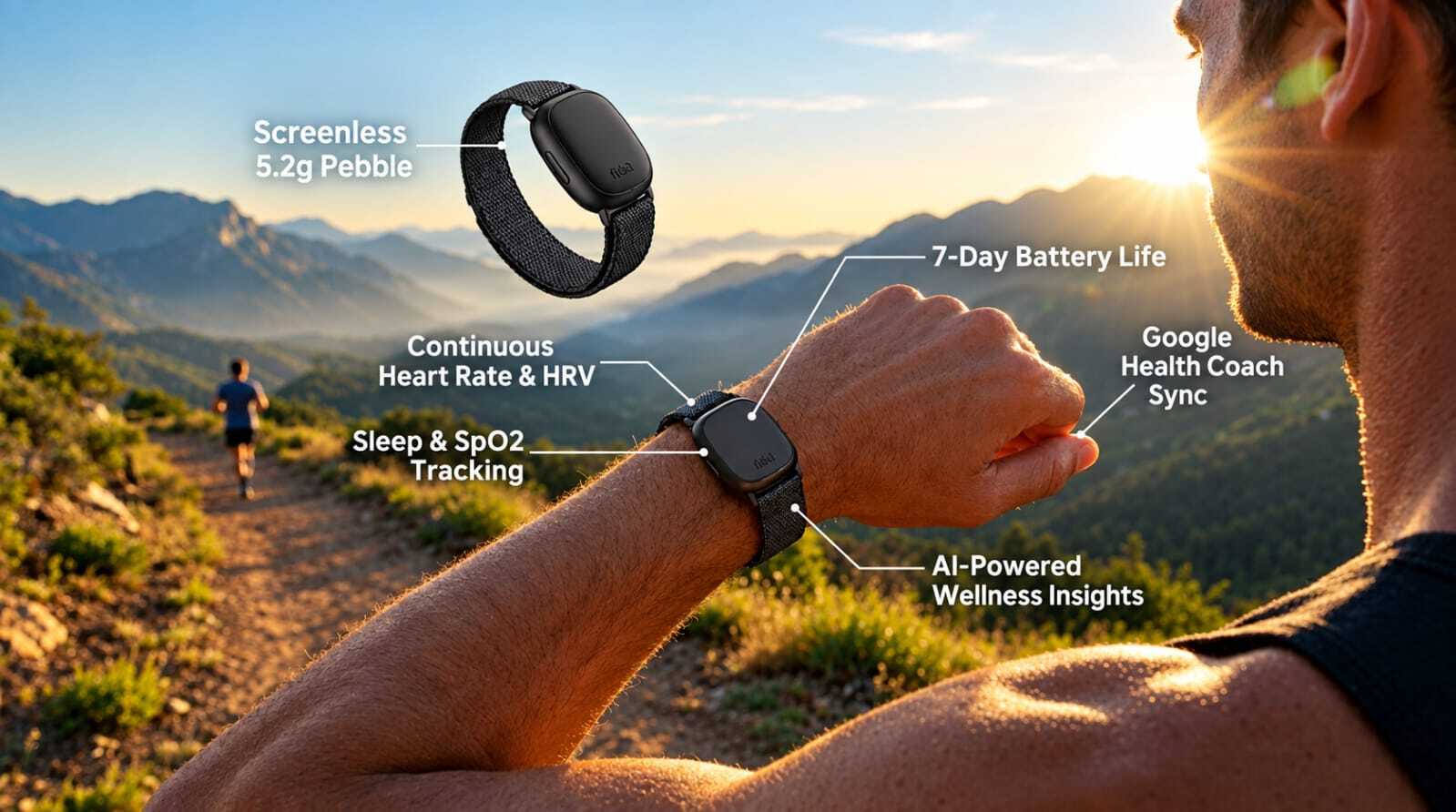
Most wearables compete on how much they can show you on your wrist. Google's newest Fitbit does the opposite. The Fitbit Air has no display, no notifications and no watch face, only a small LED that lights up when you double-tap it. It went on sale in India on 2 October at ₹13,999.
What it actually is
The Air is a tiny sensor "pebble" that clicks into swappable bands. The pebble weighs about 5.2 grams, and reviewers put the whole thing at around 12 grams with the band on. It records heart rate, sleep, SpO2 (blood oxygen, measured with red and infrared light), HRV (the small variations between heartbeats, often used as a recovery indicator), breathing rate and skin temperature. It can also flag irregular heart rhythms that may point to AFib. Everything syncs over Bluetooth to the Google Health app. It is rated for 50 metres of water resistance and runs up to about seven days per charge.
Why remove the screen?
Google's argument is comfort and focus. A band this light is easier to wear through the night, which is when sleep and recovery data gets collected. Google even suggests a Pixel Watch by day and the Air at night. There is also a business reason. Screenless bands like Whoop have built a loyal following, and the Air is clearly aimed at that crowd. It can also pair with a Pixel Watch at the same time, which Whoop's band can't do with another device.
The AI coach and the subscription question
The Air's real selling point is the software. Google Health Coach, built on Gemini, reads your data and gives guidance in the app, such as workout suggestions and sleep insights. You can also log things by text, image or voice. This is Google's pitch, and reviewers say it is useful without being overwhelming. Full coaching needs Google Health Premium, though. India units come with a three-month trial. In the US the plan costs $9.99 a month, and Google hasn't published an India price for it yet. Basic tracking works without paying anything, which is a clear difference from Whoop, where the band is useless without a membership.
India price, and where it falls short
The ₹13,999 price works out to roughly $145, against $99 in the US. You can buy it from the Google Store, Flipkart, Croma, Reliance Digital and Vijay Sales. Launch card offers reportedly bring it down to about ₹12,999. It comes in Obsidian, Berry, Lavender and Fog, and the Stephen Curry edition doesn't appear to be coming to India.
The limits are the usual ones for this kind of device:
- It has no GPS, so you need your phone with you to record a run route.
- You can't see your pace or heart rate mid-workout.
- Automatic workout detection only kicks in after about 15 minutes.
- Reviewers report that heart rate readings are less steady during intense intervals and weightlifting.
For serious athletes, Whoop or a Garmin will still make more sense.
Will it matter, or is it a novelty?
The category looks real. Plenty of people don't want another screen demanding attention, and an optional subscription is easier to accept than a compulsory one. The harder question in India is price. A basic smartwatch with a screen costs far less, so ₹13,999 is a lot for something that only shows its data on your phone. The Air makes the most sense for people who care about sleep and recovery trends and want a band they forget they're wearing. If you want a running watch or a notification device, look elsewhere.