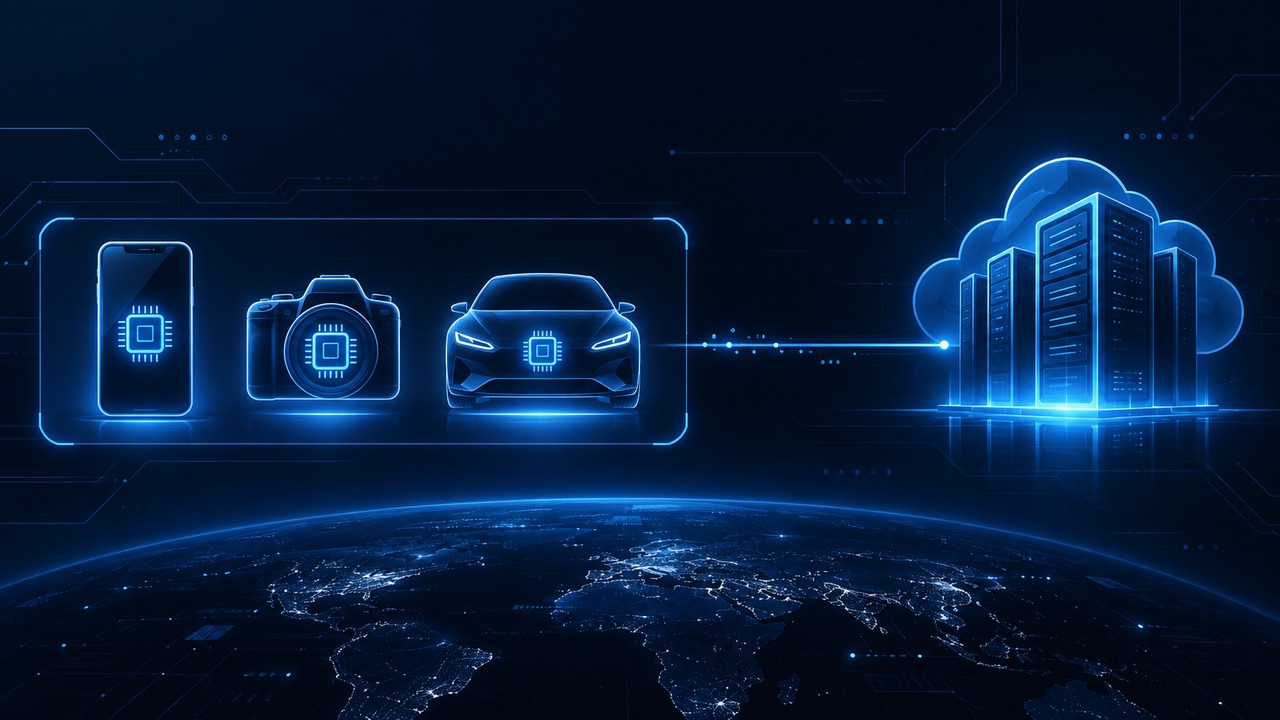
When a Tesla on Full Self-Driving needs to decide whether to brake, it can't send that decision to a server and wait for an answer. The car has to figure it out itself, in milliseconds, using a computer built right into the vehicle. There's no time for a round trip to the cloud. And there's no signal to rely on anyway if you're driving through a tunnel or a stretch of highway with no coverage.
That's the whole idea behind edge AI, in one example. Some decisions are too fast, too private, or too important to leave the device.
What "edge AI" and "NPU" actually mean
Edge AI means running an AI model directly on the device in your hand, on your dashboard, or inside a camera. Instead of sending your data to a distant server and waiting for a reply, the device does the thinking itself, right where the data already is.
Most modern phones and cars can do this because they have a chip called an NPU, short for neural processing unit. A regular processor is built to handle lots of different tasks reasonably well. An NPU is built to do one thing very efficiently: the specific math behind AI models. Apple calls its version the Neural Engine. Qualcomm calls its Hexagon. Tesla built its own chip for the same job inside its self-driving computer. Think of it as a specialized muscle the device flexes only when it needs to run AI.
Speed: why waiting for the cloud isn't always an option
Sending data to the cloud and back takes time, even on a fast connection. That delay might be barely noticeable for a chatbot reply, but it's completely unworkable for a self-driving car reading a camera feed, or a phone unlocking the instant you glance at it. Tesla's onboard computer processes video from its eight cameras and makes driving decisions locally, specifically because waiting on a network connection isn't an option when a decision has to happen in a fraction of a second.
The same logic applies to smaller, everyday features. Live translation, predictive text, and photo recognition on your phone all run on-device because even a half-second delay would make them feel broken, even though that delay is nothing in cloud terms.
Privacy: keeping your data where it already is
If an AI feature runs entirely on your device, your data usually never has to leave it. Apple has built its whole AI strategy around this idea. Apple Intelligence runs many features directly on the iPhone's Neural Engine, and only sends a request to the cloud, through a system Apple calls Private Cloud Compute, when a task genuinely needs more power than the phone has. Apple says personal data used this way isn't stored or made accessible to Apple or anyone else, and it lets independent researchers check that this claim actually holds up.
This is also why some Apple Intelligence features come with daily usage limits and others don't. In September 2026, Apple confirmed that Siri AI, Image Playground, and other server-based features would be capped this way, with the option to pay for expanded access once you hit the limit. The on-device features aren't part of this at all, because your phone is already doing the work itself, with no shared server capacity to ration.
Working without a connection at all
A feature that runs on-device usually keeps working even with no internet connection, and that matters more often than people expect: a flight with no WiFi, a parking garage with no signal, a rural drive with patchy coverage. A voice assistant that only works online becomes useless right when you might need it most.
This is a safety issue in some cases too, not just a convenience one. A self-driving system that stopped working the moment it lost signal would be a real problem. That's part of why safety-critical driving decisions are built to run locally instead of depending on a live connection.
The trade-off: why not everything runs on the device
None of this means cloud AI is going away. On-device chips are smaller, run on batteries, and have to manage heat, so they can only run smaller, more efficient models. Apple's own on-device model has a few billion parameters. The much larger models capable of harder reasoning or more creative tasks generally need the kind of computing power only a data centre can provide.
That's why most companies now split the work. Simple, fast, routine, or sensitive tasks run on the device. Harder, less time-sensitive tasks get sent to the cloud. Your phone doesn't have to choose one over the other. It just needs to know which job belongs where.