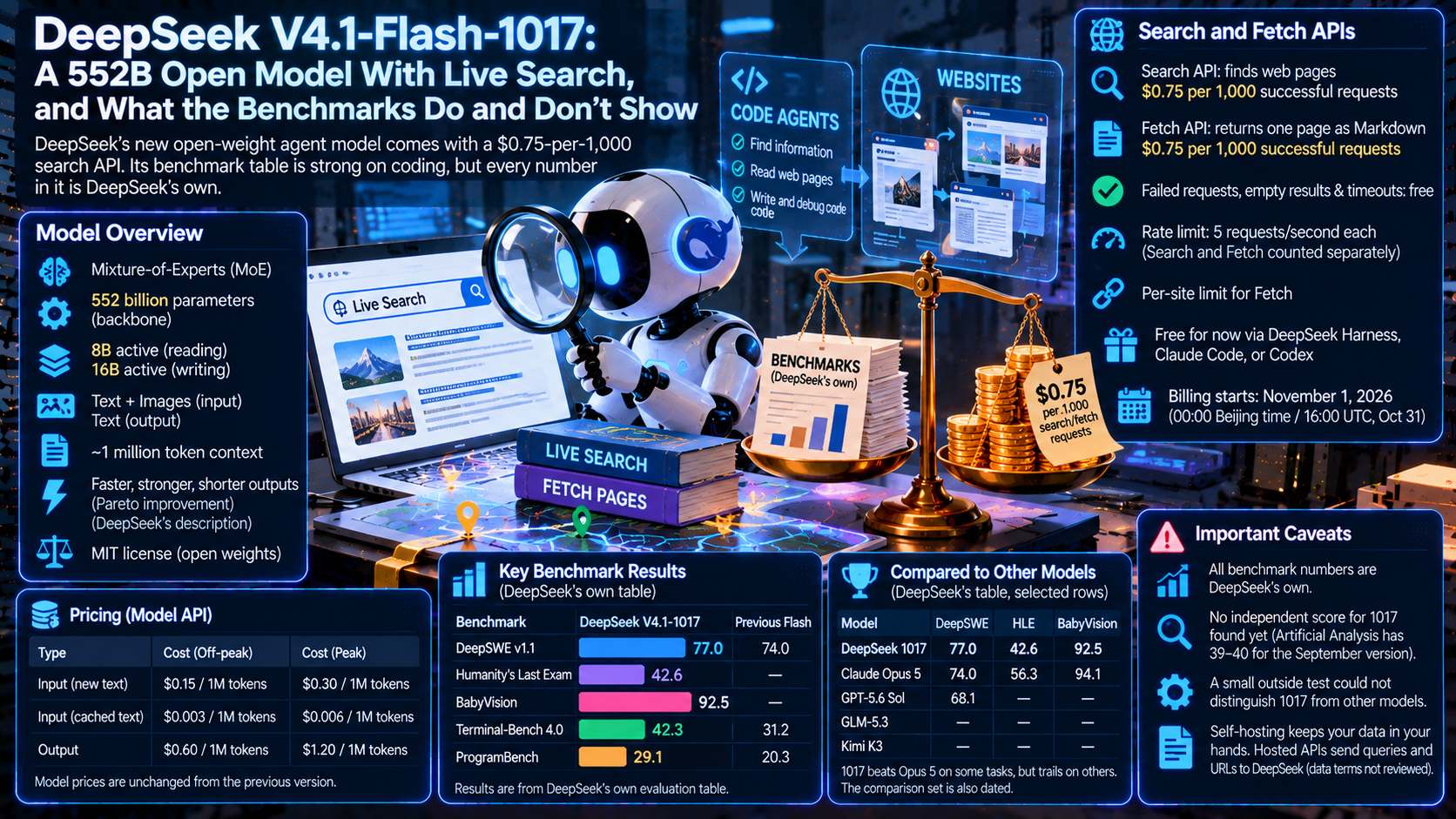
On October 17, 2026, DeepSeek released V4.1-Flash-1017, an update to its V4.1 Flash model. The weights are open under the MIT license, and the model is built for coding agents. DeepSeek also opened Search and Fetch APIs that let agents read the live web. The release is real and useful. But every benchmark number in DeepSeek’s table is DeepSeek’s own, and no independent score for this version had been found yet.
What Was Released
The model is a mixture-of-experts system. That means it holds many specialist sub-networks and uses only a few for each token, a small chunk of text. It reads text and images, writes text, and handles a context of about one million tokens. DeepSeek’s page calls the update stronger, faster, and shorter in its outputs than the last version, and a “Pareto improvement in performance and cost.” That is DeepSeek’s description.
Be careful with the size. One report of the model card gives 552 billion parameters for the backbone, with 8 billion active while reading a prompt and 16 billion while writing. It also lists 196 billion extra memory parameters, and Hugging Face labels the repository at 763 billion. Those are different ways of counting, so “552B total” is incomplete. A technical report puts the model’s attention memory, called the KV cache, at 890 bytes per token, and the model page says that is about a quarter of the old Flash.
Model prices are unchanged. Off-peak, input costs $0.15 per million tokens for new text and $0.003 for cached text. Output costs $0.60. Peak hours cost double.
What Search and Fetch Cost
The Search API finds web pages for a query. The Fetch API returns one page as Markdown text. Each costs $0.75 per 1,000 successful requests. A request is billed only if it returns a result. Failed requests, empty searches, and timeouts are free. Each account is limited to 5 requests per second on Search and 5 on Fetch, counted separately. Fetch also has a per-site limit.
Calls made through DeepSeek Harness, Claude Code, or Codex are free for now. Billing starts at 00:00 Beijing time on November 1, which is 16:00 UTC on October 31. At the list price, 1,000 searches plus 1,000 fetches cost $1.50, which can add up for an agent that loops.
What the Benchmarks Show
DeepSeek’s table gives 1017 a 77.0 on DeepSWE v1.1, 42.6 on Humanity’s Last Exam (HLE), and 92.5 on BabyVision. Against the previous Flash, scores rise on all 11 rows. The biggest jumps are on Terminal-Bench 4.0, from 31.2 to 42.3, and ProgramBench, from 20.3 to 29.1.
Against rivals, the picture is mixed. The table compares 1017 with Claude Opus 5, GPT-5.6 Sol, GLM-5.3, and Kimi K3. 1017 beats Opus 5 on four of 11 rows, including DeepSWE, 77.0 against 74.0. It trails on seven, including HLE, 42.6 against 56.3, and BabyVision, 92.5 against 94.1. It beats GPT-5.6 Sol on nine rows. So “roughly on par with Opus 5” fits some tasks and not others.
The comparison set is also dated. GPT-5.6 Sol and Opus 5 have been followed by GPT-6 Astra, GPT-6.1 Sol, and Opus 5.5. A review that cites Google’s model card lists DeepSWE scores of 77.9 for Gemini 4 Argon and 74.2 for Opus 5.5, but 66.4 for Opus 5.5 on Terminal-Bench 4.0 against DeepSeek’s 42.3. Those come from different harnesses and settings, so they are not a controlled ranking.
What Is Independent and What Is Not
Artificial Analysis, an independent testing firm, scores the September version of V4.1 Flash at 39 to 40 on its Intelligence Index, depending on the listing. It also notes the model is wordy, at 250 million output tokens against a median of 130 million. No listing for 1017 was found.
A small outside test by Kingy AI had 1017 pass all 14 first submissions on seven fixed tasks at a low reported cost. Three of four models also passed all 14, so the test could not tell them apart, and its authors say AI helped prepare it.
Self-hosting the weights keeps your data in your hands. The hosted APIs send queries and URLs to DeepSeek, and DeepSeek’s data terms were not reviewed for this article.
What Could Come Next
In the near term, expect independent scores for 1017 and real bills once Search and Fetch billing starts. Running the full model yourself needs serious hardware, so most teams will try the API first.
The long-term picture is speculation. If open weights this close to frontier coding scores stay cheap, rivals may face pressure on price and search tooling. Whether 1017 holds up outside DeepSeek’s own tests is the open question.