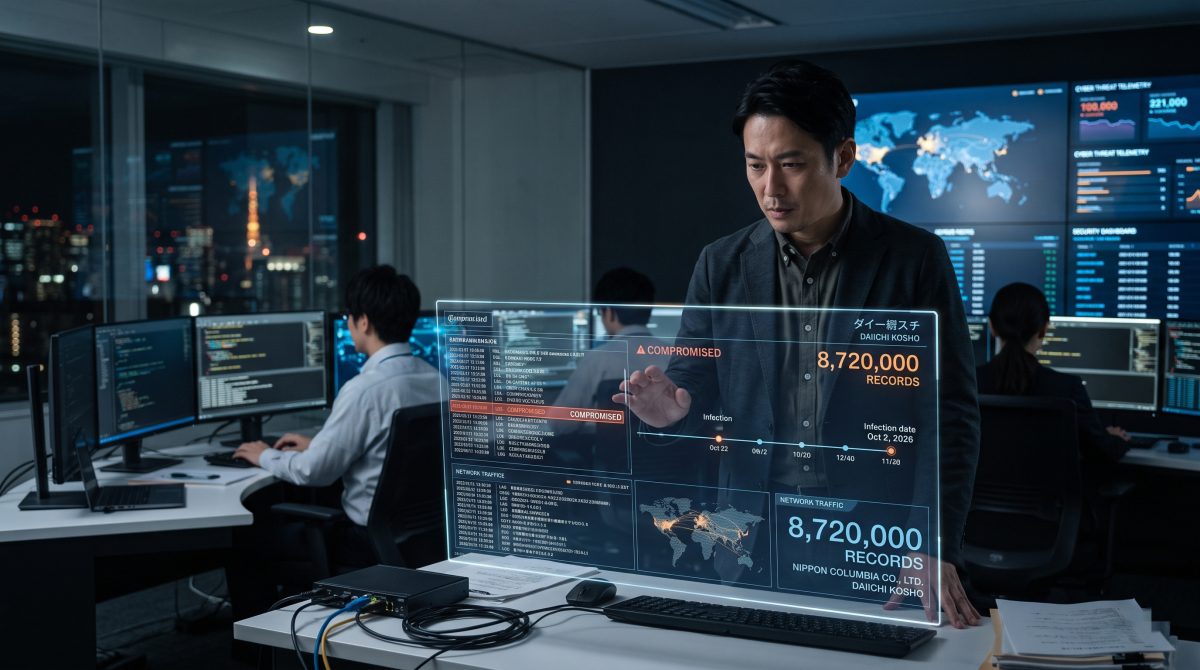
Daiichi Kosho, the Japanese company behind the Big Echo karaoke chain, said on 8 October 2026 that malware on a contractor’s computer may have exposed about 8.72 million customer and employee records. The infected machine belonged to Nippon Columbia Group, which handles personal data on Daiichi Kosho’s behalf. The company says no leak or misuse has been confirmed and that it has found no impact on its own systems. A 9 October update added a toll-free helpline.
What Data May Have Been Exposed
According to Daiichi Kosho’s notice, about 8.63 million customer records and 93,000 employee records may have been exposed, for a total of about 8.72 million. The customer records cover people who registered as members or made bookings at its venues. Each record may include a registered name, gender, date of birth, email address and telephone number. Passwords were not included, so the information alone cannot be used to spend loyalty points. The company says the figure reflects what is known at present.
The notice breaks the customer figure down by brand: about 5.56 million records for Big Echo, 3.46 million for DK Dining, 74,000 for Karaoke CLUB DAM, 43,000 for Mega Big, 5,000 for Banana Club and 4,000 for B-GARAGE. It then subtracts about 515,000 records that appear under more than one brand, giving the 8.63 million customer total. BleepingComputer lists the same six brands as potentially affected.
How the Infection Unfolded
Daiichi Kosho says Nippon Columbia Group found malware on one employee computer between 1 and 2 October 2026 and cut it off from the network on 2 October. The contractor reported to Daiichi Kosho on 5 October. The computer had temporarily held personal data linked to outsourced work. The contractor has reset passwords and other login credentials and is investigating the cause and extent of the damage, including whether any data was actually leaked. As of 11 October, BleepingComputer could not find a public statement from Nippon Columbia Group and said it had asked the company for comment.
Regulator Alert Arrives in the Same Week
Japan’s Personal Information Protection Commission published a written alert for businesses on 7 October 2026, a day before Daiichi Kosho’s notice. According to Impress’s INTERNET Watch, it lists five technical safeguards: access control, user authentication, protection against unauthorised access and software, preventing leaks during system use, and early detection of intrusions. The outlet added that the alert also lists nine typical leak cases, among them inadequate supervision of group companies. Neither the regulator’s page nor the Impress report links the alert to this incident.
Our Own Analysis: What the Numbers and the Pattern Show
This section is our own reading of the published figures. The notice counts records, not people, and does not say how many individuals are affected. Adding the six brand figures gives about 9.15 million records before the overlap is removed, so the 515,000 duplicates are roughly 6 percent of that gross total. Big Echo makes up about 61 percent of the gross figure and DK Dining about 38 percent.
Other incidents that week offer a comparison. ITmedia’s @IT counted five companies, including Daiwa Securities, Citizen Watch and Sompo Japan, whose customer inquiry data may have been exposed through what appears to be one shared vendor, Scala Communications. Each said the system accessed belonged to the contractor, not to them. The figure there is up to 713,126 inquiries, counted per inquiry with duplicates, so it is not directly comparable. Even so, Daiichi Kosho’s total is about twelve times larger.
A closer comparison is Yakiniku King. ITmedia reported that its operator, Monogatari Corporation, said on 5 October that a third party had accessed its member management system, affecting 10,788,963 of 10,808,784 accounts, about 99.8 percent. The scale is similar, but the route differs: an attack on the company’s own system rather than one contractor computer. ITmedia says date of birth and gender were not part of that leak, while Daiichi Kosho’s notice lists both, which gives scammers more to work with.
Our view is that the pattern matters more than any single case. Customers face risk from companies they never dealt with directly, and a statement that a firm’s own systems show no impact says little about where their data sat. Daiichi Kosho’s notice says it will examine how it manages its contractors, which is the question this incident raises.
What Customers Can Do Now
In its official notice, Daiichi Kosho says leaked details could be used for impersonation emails and phishing fraud. It asks customers to be careful with suspicious emails, text messages and calls and not to open unfamiliar links or attachments. The notice also states that the company never asks customers for passwords or credit card details. A dedicated helpline, 0120-732-079, is open from 10 am to 5 pm, Monday to Friday except public holidays. Questions can also be sent to incident-desk@dkkaraoke.co.jp. The company says it will announce any new findings.