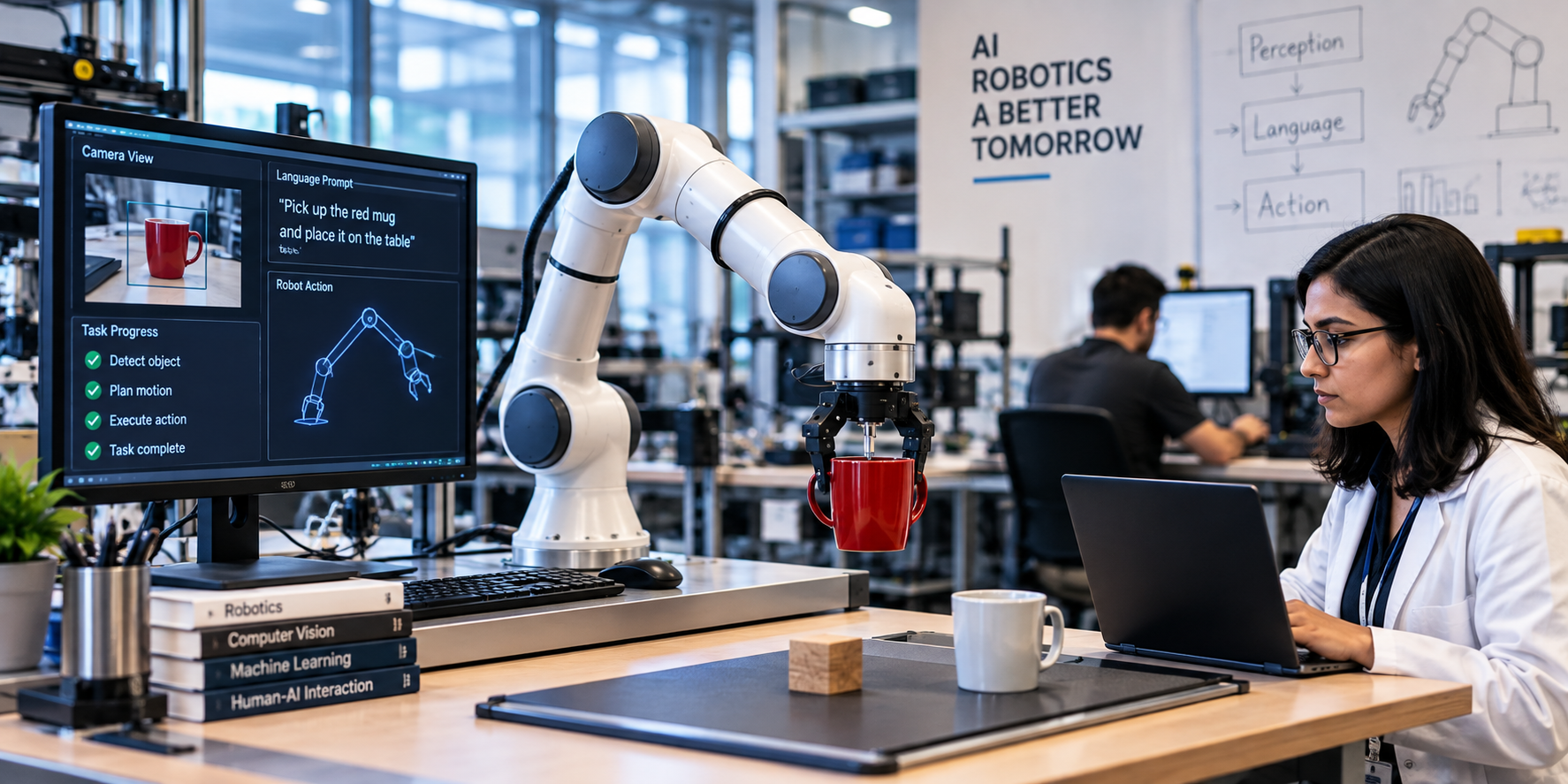
Asking a computer to identify a mug in a photograph is straightforward; asking a robotic arm to perceive a cluttered kitchen counter, recognize a specific mug, adjust its gripper angle, and hand it to a person without spilling liquid is immensely complex. Vision-Language-Action (VLA) foundation models solve this challenge by integrating perception, language comprehension, and physical motor actuation into a single multimodal network.
What VLA models do: unifying sight, language, and motion
Historically, robotic systems operated as disconnected modules: an object detector identified bounding boxes, a motion planner computed collision-free joint trajectories, and a low-level PID controller drove motor torques. If the object detector misclassified an item, the entire pipeline failed. VLA models eliminate this modular vulnerability by training monolithic transformer architectures (e.g., RT-2, OpenVLA, π0) on internet-scale vision-language datasets combined with millions of robotic teleoperation logs.
How tokenized actions and flow-matching heads generate trajectories
VLA architectures operate through two main formulations. Discrete Autoregressive VLAs map 7-DoF robot arm movements into discrete action tokens, treating motor control like word generation in large language models. Continuous Flow-Matching VLAs output high-frequency vector fields that generate smooth 50 Hz trajectory chunks, allowing bimanual robots to perform delicate, continuous tasks such as folding cloth or inserting plugs.
Deployment in Indian e-commerce fulfillment and logistics
In rapidly growing Indian logistics and e-commerce supply chains (e.g., Flipkart, Amazon India fulfillment centers in Bengaluru and Gurgaon), bin-picking and item sorting remain labor-intensive. Traditional industrial robots require fixed CAD templates for every item. Deploying VLA foundation models allows robotic manipulators to pick up novel, un-cataloged inventory items based on simple verbal or text instructions (e.g., "pack the yellow shampoo bottle into the shipping box").
Leading Indian Robotics Companies & Commercial Products
Domestic robotics ventures and deep-tech research groups are deploying vision-language-action intelligence a cross manufacturing and supply chain environments:
Addverb Technologies (Trakr & Heal): Advanced robotics manufacturer building embodied AI platforms that combine vision-language inputs with multi-joint arm controllers for complex pick-andplace warehouse tasks.
Cynlr / Cybernetics Laboratory (CL Visual Intelligence Stack): Bengaluru robotics startup engineering vision-to-action manipulation engines that allow industrial robot arms to perceive and handle unstructured objects zero-shot.
Ati Motors & IIT Madras AI-Robotics Lab (VLA Industrial Pilot): Collaborative research and industrial initiative developing vision-language-action cross-embodiment controllers for unstructured materials handling.
Hardware realities: bandwidth limits, latency, and tactile blindness
While VLAs demonstrate impressive zero-shot generalization, physical deployment reveals significant hardware bottlenecks. Large vision-language transformer backbones require substantial GPU memory, causing inference latency delays that hinder high-rate reflex recovery when an object slips. Additionally, current VLAs rely almost exclusively on RGB camera inputs, lacking high-bandwidth tactile sensing to judge gripping pressure or surface texture.
Commercial reality: lab prototypes versus real-world adoption
At present, VLA models are active in academic and corporate research labs (Open X-Embodiment, Physical Intelligence, IIT Madras). Commercial adoption is beginning in structured warehouse picking trials, while full deployment in unstructured consumer homes remains a medium-term goal dependent on lighter, edgedeployable model compression.