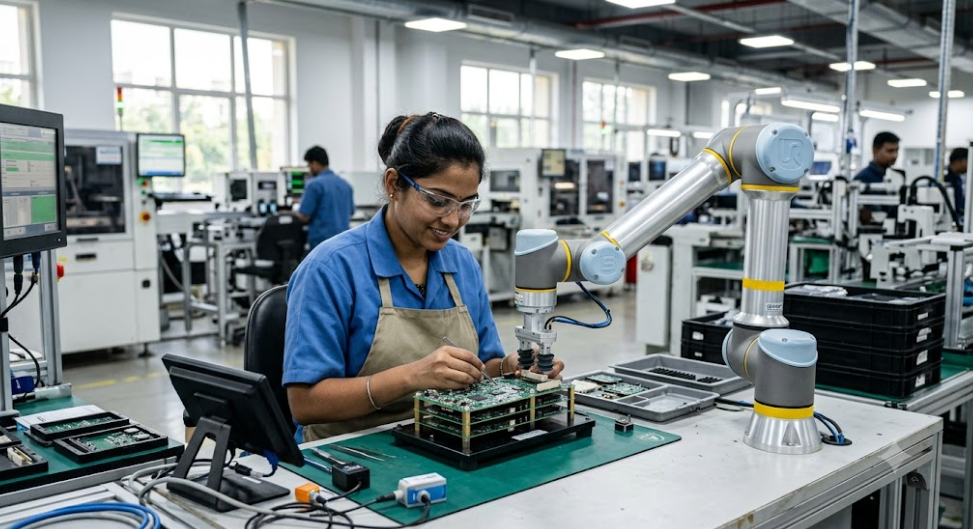
A robot does not always have to work separately from people. Collaborative robots, or cobots, are designed for applications where robots and humans can share a workspace. Instead of completely replacing workers, cobots are mainly used to handle repetitive, precise or physically demanding tasks while people focus on judgment, inspection and problem-solving.
What Makes a Cobot Different?
Traditional industrial robots often operate at high speed and are separated from workers using fences or other safeguarding systems. Cobots are designed with safety functions that can support closer human-robot interaction.
Important collaborative safety methods include power and force limiting, speed and separation monitoring, safety-rated monitored stops and hand guiding. However, calling a robot a “cobot” does not automatically make the entire application safe. The robot, gripper, tool, workpiece, speed and surrounding environment must all be considered through a risk assessment.
How Do Cobots Work Safely?
Cobots can use force sensors, cameras, proximity sensors and safety systems to detect people or unexpected contact. Depending on the application, the robot may slow down, stop or change its movement when a person enters a monitored area.
The 2025 editions of ISO 10218-1 and ISO 10218-2 updated the industrial robot safety framework. These standards emphasize safety requirements for robots and their complete applications. This is important because the same robot may be safe for one task but require additional protection for another.
Where Are Cobots Used?
Cobots are used in many manufacturing activities, including:
· Assembly and screwdriving
· Machine tending
· Packaging and material handling
· Inspection and quality checking
· Welding and dispensing
· Palletizing and other repetitive operations
They are especially useful when humans need to handle variations while robots perform repetitive movements consistently.
How AI Is Changing Cobots
AI is making collaborative robots more flexible. Modern research is exploring computer vision, AI-based perception, task planning, force sensing and natural-language interaction.
For example, AI can help a robot understand its surroundings, identify objects and decide how to complete a task. Research published in 2026 shows growing interest in combining collaborative robotics with large language models and vision-language models for perception, reasoning and task planning.
However, AI does not replace safety engineering. AI-controlled robots still require defined safety limits, monitoring and human oversight.
Cobots in India
India is actively developing its robotics ecosystem. In February 2026, the Government of India's Technology Advisory Group discussed a strategic roadmap for robotics, including research, funding, testing facilities, safety and development of advanced robotic technologies.
Indian smart factories are also exploring cobots together with AI, sensors and extended-reality technologies to improve worker training, safety and productivity.
Benefits and Limitations
Cobots can reduce repetitive physical work, improve consistency and provide flexible automation. They can also be useful for smaller production environments where traditional automation may be difficult to install.
But cobots are not suitable for every job. High-speed production, heavy payloads or dangerous tools may require conventional industrial robots and additional safeguarding. Integration, programming, safety assessment and worker training are also important.
The Future
The future of cobots is moving toward AI-powered, sensor-rich and more adaptable robots. The goal is not simply to replace humans, but to combine human decision-making with robotic precision and endurance.
The most important idea is simple: the future factory is not necessarily humans versus robots—it is humans working with robots.