India’s cyber agency has a warning for lenders and payment companies: hackers are pulling money out through the same payment links those firms use every day. On 9 October 2026, the Indian Computer Emergency Response Team (CERT-In) issued an advisory on payment API attacks and rated it Critical. An API (application programming interface) is a link that lets one system give orders to another. CERT-In says the attacks are already happening, and that in recent cases the gap between break-in and theft has shrunk sharply.
What CERT-In Found
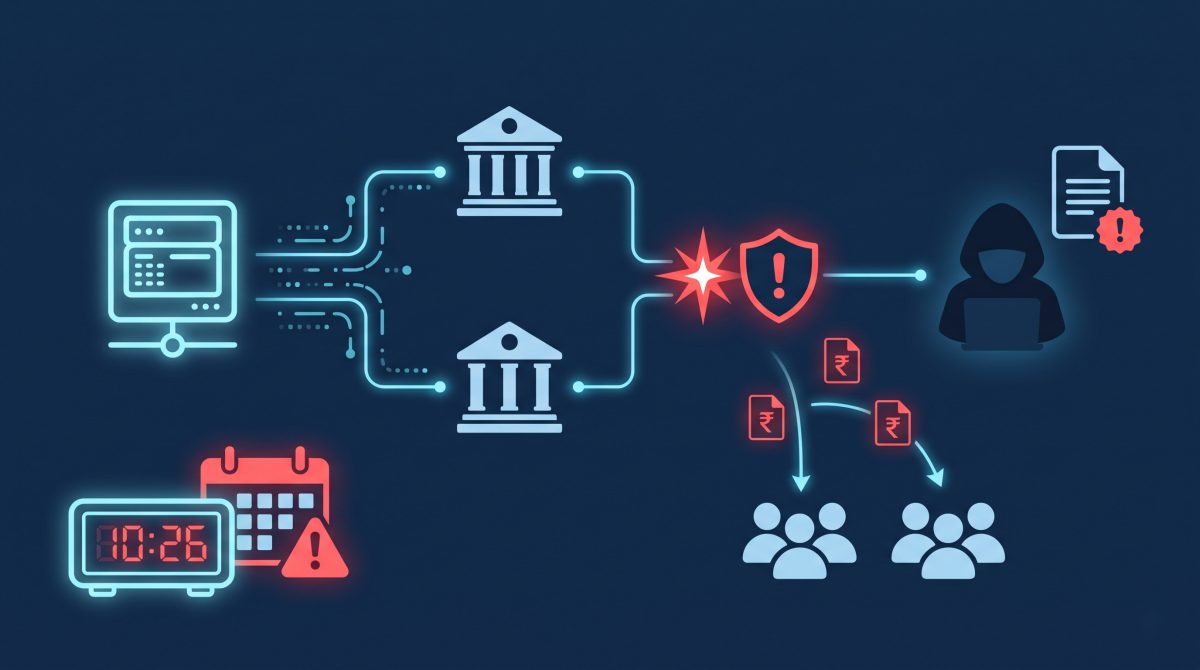
CERT-In says it has tracked several attack campaigns against non-banking financial companies (NBFCs), digital lending platforms, fintech firms, payment service providers and wallet operators. Hackers break into an app or API that is open to the internet. They steal the login keys that connect the company to payment gateways and partner banks. Then they call the money-transfer APIs directly, from the company’s own trusted servers. That lets them skip checks like loan approval, know-your-customer (KYC) verification, beneficiary checks and per-transaction limits. The money ends up in mule accounts, bank accounts criminals use to move stolen money, across several banks.
How the Hackers Get In
The advisory lists several weak spots. They include unpatched web applications, old or unused APIs that let anyone upload files, access tokens hard-coded into source code, passwords saved in plain text, and services with no multi-factor authentication (MFA). It also mentions forged commits in code repositories. Once inside, attackers plant backdoors, study the payment databases and wipe logs. They then send several large transfers over the Immediate Payment Service (IMPS) and National Electronic Funds Transfer (NEFT) systems. Most attacker IP addresses trace back to hosting providers.
Is AI Involved?
CERT-In says its analysis points to the possible use of artificial intelligence (AI) tools, along with large numbers of custom scripts. The advisory does not confirm that AI was used. The agency also issued a separate advisory on 15 October about AI agents as attack vectors against Indian systems. We have not treated that notice as proof that AI was behind these payment thefts, because it covers a different subject.
What Companies Should Do
CERT-In wants companies to switch on MFA for payment systems and remote access, list every API they run and shut down the unused ones, and replace long-lived tokens with logins that expire each session. Every money transfer should need a second person’s approval and match an approved record, and daily and per-transaction limits should apply. Keys should sit in a secure vault, logs should be stored for at least 180 days, and anything suspicious should be reported to CERT-In.
Our Analysis
This is our own reading, not a stated fact. The advisory reads less like a story about clever hackers and more like a list of basic mistakes: forgotten APIs, keys in code, no MFA. Once attackers hold valid keys, their requests look normal, so a strong firewall alone will not catch them. Smaller firms with thin security teams may take longest to fix things. The advisory gives no loss figure, so the scale of the damage is still unknown. That is our reading, not a finding.