Can Swarms of Small Drones Search an Area Faster Than One Large Drone?
Distributed coverage vs heavy-lift endurance: why decentralized micro-drone swarms outperform single aircraft in search missions, and the real-world battery and communication bottlenecks holding them back.
Published: Oct 07, 2026
5 mins read
👁️ 8 Unique Views
When a hiker goes missing in a dense wilderness or a disaster strikes a city, search-and-rescue teams face a race against time. Traditionally, emergency services deploy a single, expensive heavy-lift drone equipped with high-resolution thermal cameras and long-range batteries. However, robotics researchers are asking a radical question: could a fleet of ten small, inexpensive micro-drones search the same area faster and more reliably than one powerful aircraft?
The Single-Drone Coverage Bottleneck
While a large multirotor drone can carry thermal optics and fly for 45 minutes, it faces physical limitations in search operations. A single drone must fly back and forth in a linear "lawnmower" grid pattern. In mountainous terrain or dense forests, trees block the camera's line of sight, requiring multiple slow sweeps. Furthermore, relying on a single aircraft creates a single point of failure: if a motor fails or a battery overheats, the entire search operation halts immediately.
How Swarm Coordination Works: Decentralized Voronoi Coverage
Roboticists at Zhejiang University's Field Robotics Lab, led by Fei Gao, tackled this challenge by building fully autonomous micro-drone swarms capable of navigating unmapped environments. Their findings, published in Nature and Science Robotics, demonstrated how small drones coordinate without human intervention.
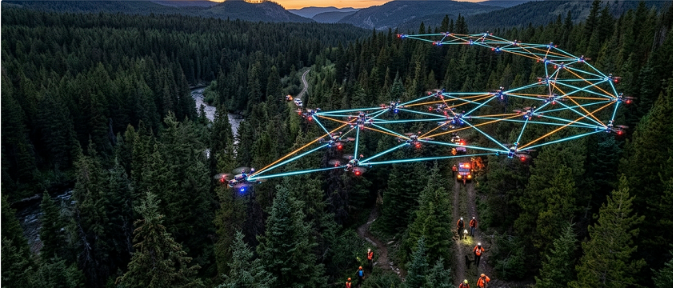
Instead of relying on a central ground control computer to assign paths, each micro-drone uses decentralized algorithms to calculate spatial boundaries called Voronoi tessellations. As the swarm flies forward, individual drones continuously broadcast their positions to nearby neighbors over a localized mesh network. Each drone dynamically claims an unsearched slice of territory, adjusting its flight path in milliseconds to avoid colliding with trees or peer drones.
What Field Trials Revealed: 4.2x Faster Area Coverage
In field experiments conducted across 100,000 square meters of dense, unmapped bamboo forest, a swarm of 10 palm-sized micro-drones searched the environment 4.2 times faster than a high-end single inspection drone. By spreading out across multiple visual angles simultaneously, the swarm eliminated camera blind spots caused by dense tree branches.
Furthermore, field trials at UPenn's GRASP Lab demonstrated swarm resilience. When researchers intentionally disabled two drones mid-flight to simulate battery failures or collisions, the remaining swarm members detected the missing signals and instantly recalculated their coverage grids to fill the gap, completing 100 percent of the search mission without stopping.
The Real-World Trade-Offs: Battery Size vs. Payload Capacity
Despite their speed advantages, small drone swarms face strict physical trade-offs. Palm-sized drones carry miniature batteries that limit flight endurance to 12 to 18 minutes, compared to 45 minutes for heavy-lift aircraft. Additionally, small drones cannot carry heavy, cooled thermal cameras or long-range radar systems, relying instead on lightweight optical sensors that struggle in night conditions.
The Communication Bottleneck in Dense Mesh Networks
Another major challenge explored by researchers at ETH Zurich Autonomous Systems Lab is radio frequency congestion. As swarm size grows beyond 20 or 30 drones, transmitting video streams and positional updates simultaneously over Wi-Fi or ultra-wideband (UWB) frequencies creates packet loss and signal delay. When radio signals get crowded, drones must drop video quality or slow down flight speeds to prevent mid-air collisions.
Why Distributed Swarm Robotics Is the Future of Search Missions
While single heavy-lift drones remain valuable for long-distance transport and specialized thermal imaging, multi-drone swarms represent a major shift in search-and-rescue efficiency. By distributing mission risks across many low-cost units, swarm robotics provides rapid spatial coverage that saves crucial time when lives are on the line.