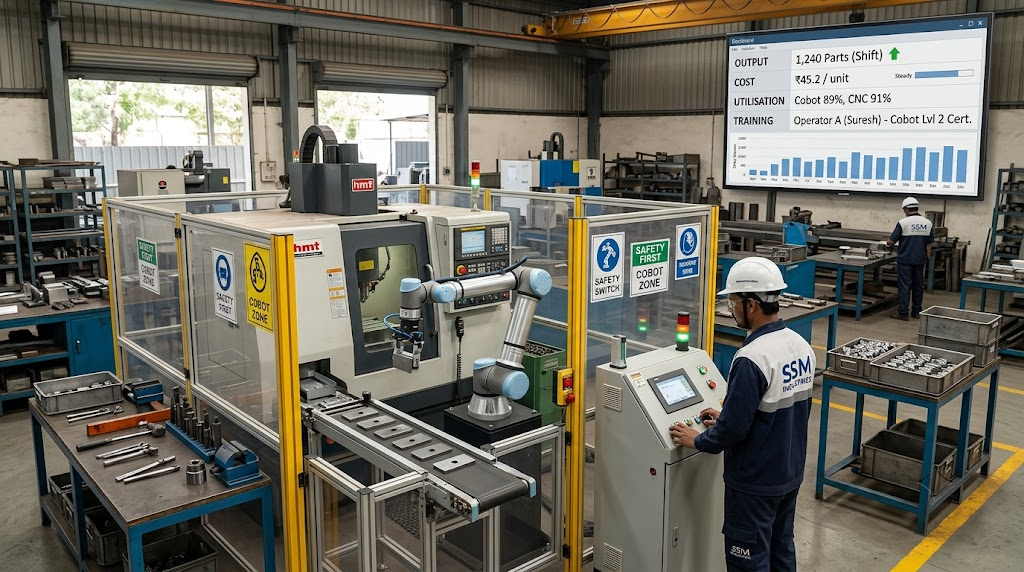
The Robot Is Only Part of the Bill
A small factory does not buy just a robot. A practical automation project may also require a gripper or other end-effector, fixtures, safety equipment, cameras, programming, installation and integration with existing machines.
That changes the investment calculation considerably. A robot that looks affordable on its own can become much more expensive when converted into a complete production cell.
The right question is therefore not “How cheap is the robot?” but “How much does the complete automated task cost, and what does it produce in return?”
India's adoption is already expanding. The International Federation of Robotics reported 9,120 industrial robots installed in India during 2024, a 7% increase over 2023. Automotive remained the largest customer sector, but plastics, chemicals and metal industries also recorded growth.
Buying Is Not the Only Option
For a small manufacturer, spending a large amount of capital upfront can be difficult, particularly when production volumes are uncertain. This is where Robotics-as-a-Service (RaaS) and leasing models become relevant.
Instead of purchasing the complete system, a company may pay through a recurring arrangement. Depending on the provider, this can include equipment, software, maintenance or technical support.
The model can reduce the initial financial barrier, but it does not automatically make automation cheaper. A recent 2026 analysis of RaaS for Indian MSMEs notes that the economics depend on factors such as machine utilisation, contract terms, downtime responsibility and whether the equipment can be redeployed.
For a factory running a robot only occasionally, monthly payments may not make sense. For a repetitive operation running multiple shifts, the calculation can look very different.
Productivity Has to Pay for the Investment
Automation becomes easier to justify when it solves a specific production problem.
A robot might repeatedly weld, pick components, load a machine, inspect parts or handle material. The benefit may come from producing more parts per shift, reducing variation, avoiding repetitive manual work or maintaining consistent cycle times.
But a factory should calculate the complete picture: robot and integration cost, maintenance, programming, downtime, energy, operator involvement and expected production gains.
This is also why automating one high-volume bottleneck can make more sense for a small factory than attempting to automate an entire production line at once.
Labour Availability Changes the Calculation
India's relatively large manufacturing workforce means that replacing workers is not always the main reason to automate. In some factories, the stronger argument may be difficulty finding people for repetitive, hazardous or physically demanding tasks.
The workforce also needs to adapt. Operators may have to learn robot operation, basic troubleshooting and safe interaction with automated equipment.
Government skill-development programmes in 2026 are increasingly including robotics, automation and other emerging technologies. PMKVY 4.0, for example, includes robotics among its future-ready skill areas, while India's Skill India ecosystem supports reskilling and on-the-job training.
Start With the Task, Not the Robot
For a small Indian factory, robotics does not have to mean a completely automated factory.
A more practical approach can be to identify one repetitive operation, measure its current cost and output, and then compare those numbers with the cost of automating it.
The answer to whether small factories can afford robotics is therefore not simply yes or no. They can, in some cases, when the application, utilisation, financing model and available workforce make the economics work.
The important decision is not buying a robot. It is choosing the right task to automate.