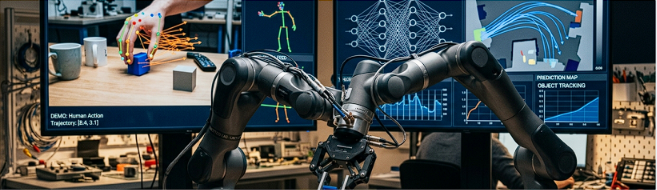
Can Robots Learn New Tasks by Watching Videos? Research on Teaching Robots Through Human Demonstrations
How researchers watch human videos to teach robots complex tasks, solving the morphological correspondence problem and leveraging generative video planners.
Published: Oct 06, 2026
6 mins read
👁️ 23 Unique Views
Over the past decade, foundation models in natural language processing and computer vision have scaled exponentially by feeding on trillions of tokens and billions of internet images. Robotics, by contrast, has been constrained by what roboticists term the "embodiment data famine". Historically, training a robot to grasp a cup, fold a shirt, or open a microwave required direct physical teleoperation—human operators wearing virtual reality headsets or manipulating physical puppet arms (such as ALOHA or GELLO) to record joint motor torques millisecond by millisecond.
This manual teleoperation pipeline is notoriously slow, ergonomically exhausting, and economically unscalable: collecting just 50,000 demonstrations can take months of human labor. Yet the internet already hosts billions of hours of unstructured human activity videos—cooking tutorials, furniture assembly guides, and crafting demonstrations on YouTube and TikTok. The central ambition of modern embodied AI is to allow system designers to watch and harness this passive sea of internet video as an autonomous physical curriculum, enabling robots to master complex manipulation tasks simply by watching humans perform them.
The Core Challenge: Solving the Morphological Correspondence Problem
Translating human video into robotic motor execution is fundamentally harder than training an image classifier. The primary obstacle is the morphological correspondence problem. A human hand possesses 27 degrees of freedom, supple muscle compliance, five articulable fingers, and soft friction-rich skin. A typical commercial robot arm (such as a 7-DoF Franka Emika or Universal Robots UR5e) terminates in a rigid two-jaw parallel gripper, a three-finger claw, or a pneumatic suction cup.
A robot cannot simply copy human joint angles because its kinematic structure is physically incompatible. Furthermore, internet videos feature vast viewpoint and background shifts: camera angles range from bouncing egocentric GoPro views to static wide-angle perspectives with complex lighting, distracting human bodies, and cluttered kitchen counters that bear no resemblance to the robot's calibrated workspace. To learn from observation (LfO), algorithms must extract the invariant semantic essence of the task such as object trajectory, spatial affordances, and contact state transitions—independent of human anatomy.
The Missing Action Problem and Inverse Dynamics Models
The deepest mathematical hurdle in video-to-policy learning is the Missing Action Problem. Standard imitation learning relies on state-action pairs, where the state is visual and the action is an exact motor command (joint torque, end-effector delta pose, or gripper width). However, internet video contains only a sequence of pixel observations without any underlying action labels. The robot can watch an onion being diced, but it has no sensor record of downward knife pressure or wrist acceleration.
To bridge this gap, researchers pioneered Inverse Dynamics Models (IDMs). As demonstrated in OpenAI's landmark Video PreTraining (VPT) in virtual worlds (Baker et al., NeurIPS 2022) and extended to physical robotics by CMU and Meta AI (Bahl et al., CoRL 2022):
-
Predicting Actions from Pixel Transitions: An IDM is trained on a small, calibrated dataset of robot teleoperation where both video and motor actions are recorded. The model learns to predict the missing action.
-
Pseudo-Labeling Web Video: Once trained, the IDM processes millions of unlabeled internet video frames, inferring the kinematic "pseudo-actions" that caused state transitions. This converts millions of passive video hours into structured behavioral cloning datasets.
Generative Video Diffusion as Physical Planners: The UniPi Paradigm
Rather than translating human videos directly into low-level motor torques, frontier research from MIT CSAIL and Google DeepMind reimagines the problem through generative text-to-video diffusion models. In the groundbreaking UniPi architecture (Du et al., NeurIPS 2023), video models do not just observe tasks—they serve as high-level physical planners.
When prompted with a goal like "pour the milk into the bowl," a pre-trained video diffusion model synthesizes a plausible sequence of future video frames depicting the completed task. A low-level inverse policy then tracks these generated frames, executing real-world motor actions to match the hallucinated video trajectory. Because web-scale video models encode vast common-sense knowledge of physics and object dynamics, they provide zero-shot spatial planning across novel objects and environments.
The Tactile Blindspot: Why Visual Observation Is Not Enough
Despite impressive visual imitation, to watch video alone cannot teach complete physical competence due to the tactile and dynamic blindspot. Video records kinematics (geometric motion), but reveals nothing about dynamics (forces, friction, mass, and compliance). A robot watching a human pick up a raw egg versus a ceramic egg sees identical hand trajectories, but applying the wrong grip force results in a shattered shell or a dropped object. High-contact manipulation—such as inserting a key, wiping a surface with variable pressure, or peeling fruit—requires closed-loop tactile feedback that passive pixels cannot provide.