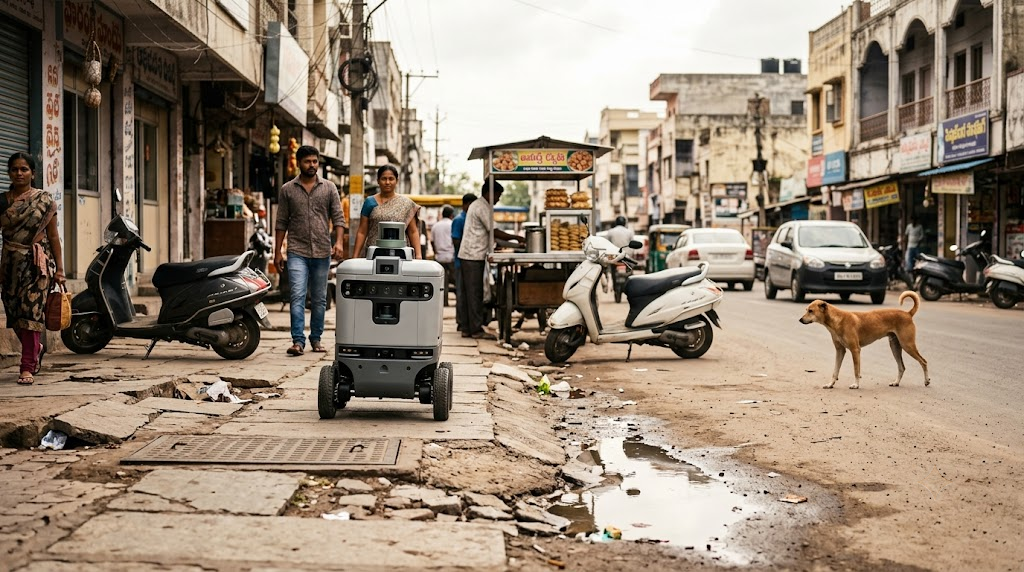
A delivery robot can navigate a carefully mapped campus or a well-maintained sidewalk, but an Indian city can present a very different challenge. A pedestrian may suddenly step into its path, a parked vehicle may block the footpath, or an uneven surface may force the robot onto a different route. For autonomous delivery, the difficult part is not simply reaching the destination. It is dealing safely with everything that changes along the way.
The Sidewalk Is an Unpredictable Environment
Sidewalk delivery robots normally rely on cameras, LiDAR, GPS or other positioning systems and onboard computing to understand their surroundings. They can identify obstacles and plan paths, but their performance depends heavily on the environment.
Indian urban footpaths can include broken pavement, drainage covers, construction areas, parked two-wheelers, street vendors and sections where pedestrians and vehicles share the same space. These conditions are very different from a controlled warehouse or a dedicated robotic test area.
This is a broader engineering problem. A 2026 study on sidewalk delivery robots found that pedestrian flows and unexpected obstacles create significant travel-time uncertainty and that conventional shortest-path planning can become unreliable in crowded conditions.
People Are Harder to Predict
A robot can detect a pedestrian, but detection is only the first step. It must estimate where that person is moving and decide whether to continue, slow down, stop or change direction.
The same problem occurs with cyclists, children and other road users whose movements are difficult to predict. Research on real sidewalk interactions has found that conflicts are more likely around narrow paths and intersections where there is less space for people and robots to move independently.
This means autonomous delivery requires behaviour prediction as well as obstacle detection.
Uneven Roads and Weather Add Another Layer
Small delivery robots are generally designed for relatively smooth surfaces. Potholes, broken pavement, steep ramps and unexpected curbs can affect wheel traction, stability and localization.
Weather can also change the environment. Rain can affect visibility and surface grip, while strong sunlight can influence cameras and shadows. The 2026 route-planning study specifically found that adverse weather and high pedestrian congestion can increase uncertainty for sidewalk robots.
For an Indian deployment, the robot would therefore need hardware and software designed around local road and weather conditions rather than simply being imported unchanged.
Animals and Temporary Obstacles
Street environments introduce another category of uncertainty: animals.
A dog, cow or other animal can suddenly enter the robot's path and then change direction. Construction barriers, delivery vehicles and temporary stalls can create similar problems.
A robot cannot simply follow a pre-programmed route when the original path disappears. Its navigation system needs to detect the obstruction, create a safe alternative route and understand when it is better to stop and request human assistance.
India Needs More Than a Good Robot
The technology itself is only one part of the problem. Large-scale deployment would also require suitable pedestrian infrastructure, clear operating rules, reliable maps, remote assistance and defined responsibility when something goes wrong.
Current industry reporting indicates that sidewalk delivery robots remain concentrated in selected overseas markets, while commercial deployment in India has not reached comparable scale.
For India, controlled environments such as planned campuses, gated communities, technology parks and industrial facilities may therefore provide more predictable starting points than unrestricted city streets.
The key challenge is not whether a robot can move without a driver. It is whether it can keep making safe decisions when the environment refuses to behave predictably.