What multimodal AI actually means
A modality is simply a type of input — text, images, audio, or video. For years, AI models handled one modality at a time. A text model read and wrote sentences. An image model worked with pixels. A speech model listened to sound. These systems mostly worked separately.
Multimodal AI brings these abilities together. A multimodal model can take several types of input and reason about them at the same time. Show it a photo and ask a question about it in text, and it can use both the image and the question to answer. By 2026, this has become a standard feature of many advanced AI systems.
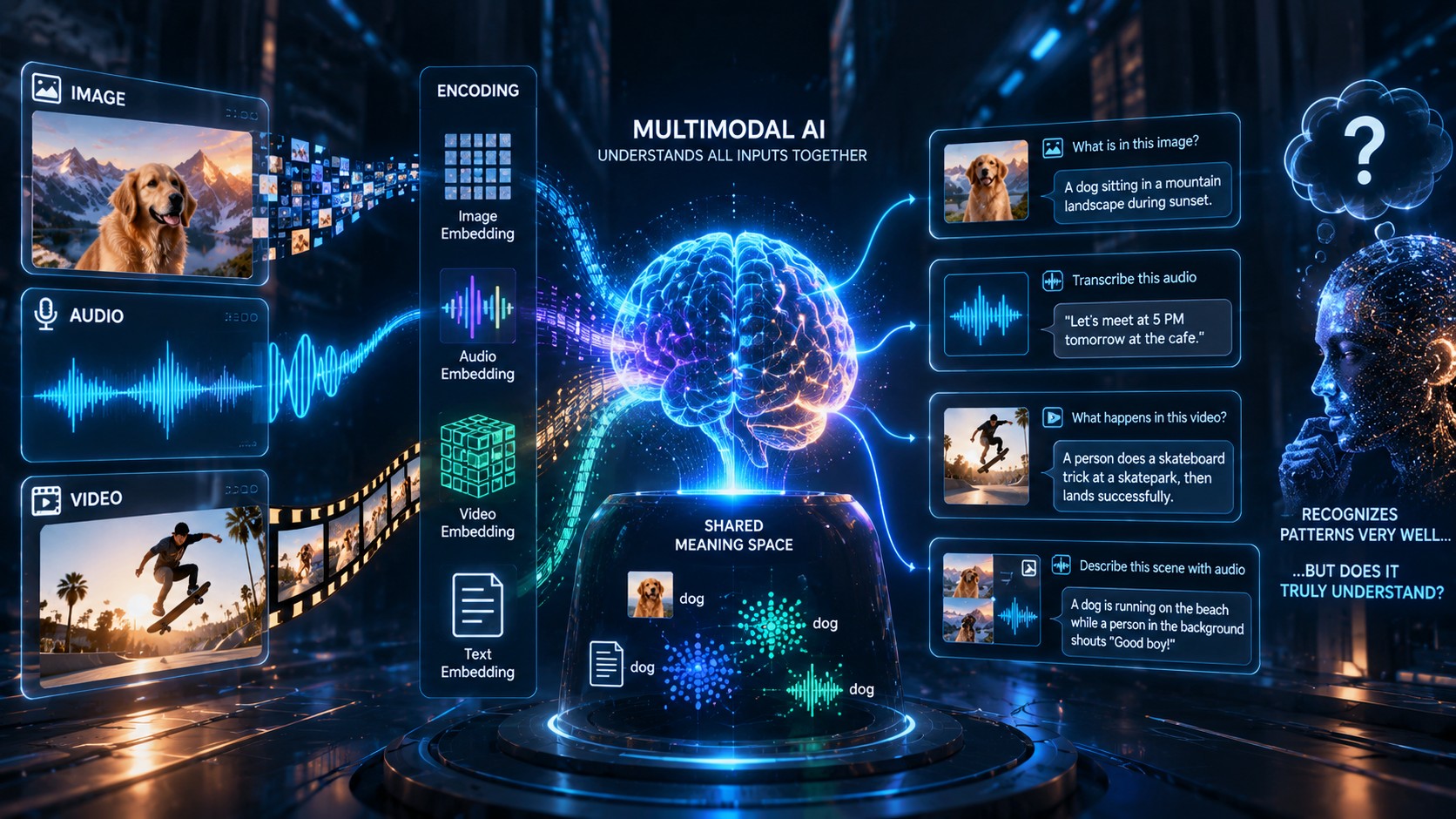
The basic idea is to turn different types of information into a shared internal representation. A sentence, photo, or sound clip can be converted into numbers called embeddings. These numbers help the model connect related ideas. A photo of a dog and the word “dog,” for example, can end up close together in this mathematical space.
That makes it possible for AI to connect information that originally came in completely different forms.
Vision-language models: connecting pictures to words
Vision-language models allow AI to look at images and describe or reason about them. Earlier systems such as OpenAI's CLIP learned connections between images and captions. By seeing huge numbers of image-and-text pairs, the model learned which visual patterns were commonly connected with words.
Modern systems can do much more. They can read charts, understand screenshots, follow handwriting, identify objects, and answer questions about what is happening in an image. Instead of simply saying “this is a picture of a car,” an AI can examine a chart and explain what changed and what the information might suggest.
But there is an important limitation. The model has never physically touched a car or stood outside in the rain. Its knowledge comes from patterns in the images, words, and other information it was trained on. It can connect these patterns extremely well, but that is not necessarily the same as experiencing the world.
Speech recognition: turning sound into text
Speech recognition is another important part of multimodal AI. Systems such as OpenAI's Whisper can turn spoken language into text with high accuracy, especially when the recording is clear.
However, accurate transcription does not automatically mean understanding. An AI can correctly write down a sentence without having the same understanding of that sentence that a human speaker has. It is possible to copy words from a language without knowing what those words mean.
Newer AI systems are also combining listening, reasoning, and speaking more closely. Instead of having one system transcribe audio, another answer the question, and another read the answer aloud, newer systems can handle these steps together. This makes conversations with AI feel much more natural.
But smoother interaction should not be confused with proof of deeper understanding.
Video understanding: the hardest challenge
Video is harder because it adds time. Understanding a video means more than identifying objects in individual frames. The AI also needs to track what changes and how different events are connected.
For example, if a cup falls from a table, the important question is not only whether the cup is on the floor. It is also what caused it to fall. Did someone knock it? Was it already tipping over? Understanding this requires the model to follow events across multiple frames.
Modern AI systems can process much longer videos than earlier models and answer questions about events that happen throughout a recording. This is a major improvement.
Still, real-time video understanding remains difficult. A system watching a live camera feed has to continuously process new information and react quickly. That is much harder than analysing a video that has already been recorded.
Pattern recognition vs. really understanding the world
This leads to the biggest question: does multimodal AI actually understand what it sees and hears?
Researchers disagree. One view is that these models are extremely advanced pattern-recognition systems. They learn relationships between words, images, sounds, and other information. They can produce convincing answers without having a direct connection to the physical world.
Another view is that humans also learn through patterns and repeated experiences. A child learns what a dog is by repeatedly seeing dogs, hearing the word “dog,” and connecting those experiences. Some researchers therefore argue that AI systems may develop a basic internal model of how the world works.
The safest middle ground is that today's AI is extremely good at finding patterns in the information it has seen. Sometimes those patterns produce answers that look exactly like understanding. Other times, the same system can confidently produce something completely wrong.
The problem is that the AI may not know when it has crossed that line.
Why this matters
This difference matters because it affects how much we should trust AI.
For everyday tasks such as describing a photo, transcribing a meeting, or creating captions, multimodal AI can already be genuinely useful. But situations involving safety, unfamiliar environments, or important decisions are different.
An AI can misunderstand an image, mishear a sentence, or misinterpret a video while still giving a confident answer. There may be no obvious warning that it is guessing.
That is why human checking remains important when the result actually matters.
The future of multimodal AI will likely involve better training data, longer context, stronger reasoning, and systems designed for more specific tasks. These improvements may gradually reduce the gap between recognising patterns and understanding the world.
But full human-like understanding is still an open question. Current AI can process images, audio, video, and text together remarkably well. Whether that means it truly understands the world — or has simply become extremely good at modelling patterns in it — is something researchers are still trying to answer.