Can AI Help Robots Feel What They Are Touching?
Inside high-resolution artificial touch: how vision-based tactile sensors, elastomeric membranes, and deep learning help robots detect micro-slip, estimate object softness, and handle delicate items with human-like dexterity.
Published: Oct 08, 2026
5 mins read
👁️ 6 Unique Views
Pick up a fresh egg, a slippery wet bar of soap, or a fragile glass vial. As humans, each of our fingertips contains approximately 2,500 mechanoreceptors that continuously measure pressure, skin shear, texture, and microscopic slippage before an item slips from our grasp. Traditional industrial robots, by contrast, operate blind to touch. Guided solely by overhead cameras and rigid joint encoders, standard robotic grippers cannot feel surface contact, forcing engineers to choose between crushing delicate items or dropping slippery ones.
The Fundamental Challenge: Why Cameras Alone Fail During Contact
To understand why artificial touch is so critical, consider what happens when a robot hand closes around an object. The moment the gripper touches the item, the hand itself blocks the overhead camera's line of sight—a condition known in computer vision as visual occlusion. Furthermore, cameras cannot measure physical properties like surface friction, internal mass distribution, or material compliance. Without touch feedback, a robot cannot tell whether a plastic bottle is full or empty, or whether a slippery surface is beginning to slide.
Vision-Based Tactile Sensing: Turning Fingertips into Microscopes
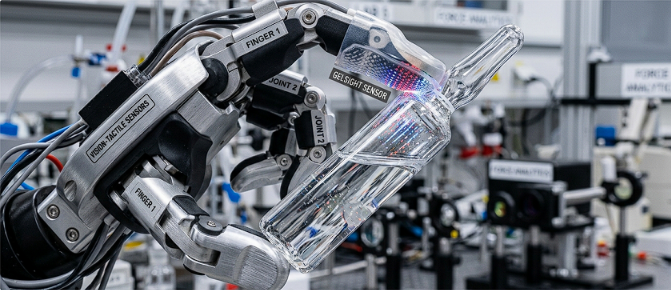
To solve this, researchers at MIT CSAIL led by Edward Adelson developed GelSight, a pioneering technology that translates touch into high-resolution visual data. GelSight sensors replace rigid plastic finger pads with a soft, clear gel membrane covered by a flexible reflective skin. Inside the finger, tiny LEDs illuminate the gel while a micro-camera captures three-dimensional deformations whenever the skin presses against an object.
When the robot touches a surface, the membrane molds around fine details like screw threads, textile weaves, or embossed text. Computer vision algorithms instantly convert these gel indentations into microscopic three-dimensional topographic maps and contact force distributions at resolutions exceeding 100 micrometers per pixel.
Detecting Incipient Slip: Preventing Drops in Milliseconds
A major breakthrough came when research teams at Meta AI FAIR, creators of the open-source DIGIT and Digit 360 sensors, and Stanford's ARMLab trained deep neural networks to monitor contact deformation fields in real time.
Instead of waiting for an object to fall completely out of the hand, known as macro-slip, neural networks analyze vector field changes in the gel to detect incipient slip—microscopic movements that occur at the edges of the contact patch milliseconds before full slippage occurs. In closed-loop manipulation tests, tactile AI controllers adjusted gripper force within 10 to 20 milliseconds, reducing drop rates by over 82 percent across hundreds of previously unseen household items.
Generalizing Touch: Foundation Models for Artificial Feeling
Earlier tactile sensors required custom calibration for every object shape. To make touch universally applicable, Meta AI introduced general-purpose tactile representation models like Meta Sparsh. Trained on vast datasets of tactile interactions, these self-supervised AI models allow robots to recognize material softness, estimate mass, and align precision tools without requiring fine-tuning for specific tasks.
Engineering Trade-Offs and Physical Durability Limits
Despite these advances, vision-tactile sensing presents clear engineering challenges. Soft elastomeric gel membranes suffer physical wear and tearing when handling sharp metallic edges or abrasive materials. Additionally, processing high-speed video streams from multiple fingertips places high computational demands on small robot arm embedded processors.
Why Artificial Touch Is the Key to General-Purpose Robotics
Giving robots a sense of touch bridges the gap between rigid factory automation and versatile human assistance. From sorting delicate agricultural produce to performing assisted surgical procedures and assembling micro-electronics, tactile feedback allows AI systems to interact safely with a fragile, unpredictable world.