Throughout human history, discovering a single new material—whether a solid-state battery electrolyte, an efficient solar cell substrate, or a room-temperature superconductor—has required decades of painstaking, trial-and-error laboratory experiments. Over centuries of scientific work, humanity has cataloged roughly 280,000 stable inorganic crystal structures. Today, artificial intelligence systems have expanded that total library nearly ten-fold in a single computational leap.
The Computational Bottleneck of Traditional Chemistry
To understand why materials discovery is historically so slow, consider how chemists test theoretical compounds. Calculating whether a candidate crystal structure is stable requires solving quantum mechanical equations using Density Functional Theory. Running a single Density Functional Theory calculation for a complex crystal can consume hours or days of supercomputer time. Because the space of potential elemental combinations is virtually infinite, evaluating millions of candidate materials manually was computationally impossible.
Graph Neural Networks: DeepMind's GNoME Breakthrough
In a landmark study published in Nature (Merchant et al., 2023/2024), researchers introduced GNoME, or Graph Networks for Materials Exploration. GNoME uses Graph Neural Networks where atoms are represented as graph nodes and chemical bonds as edges (Xie et al., 2024), allowing the model to predict structural stability thousands of times faster than quantum Density Functional Theory equations.
Using active learning loops, GNoME generated and evaluated candidate crystals, expanding humanity's known stable materials library by an order of magnitude: predicting 2.2 million new crystal structures, including 380,000 novel thermodynamically stable inorganic materials.
Autonomous Physical Testing: Berkeley Lab's A-Lab
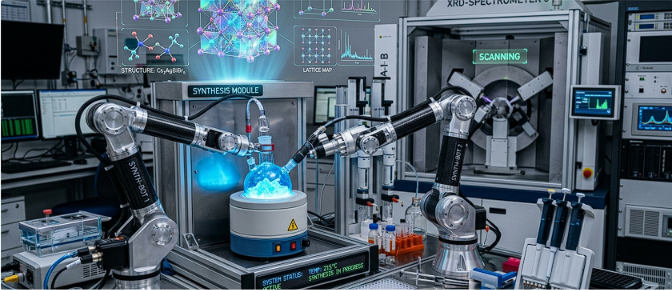
A computational prediction on a computer screen is useless unless scientists can physically make the material in a laboratory. Published alongside GNoME in Nature, researchers at Lawrence Berkeley National Laboratory and UC Berkeley unveiled A-Lab, an autonomous robotic laboratory.
A-Lab operates without human intervention. Controlled by artificial intelligence planning software, robotic arms select raw chemical powders, mix them in precise ratios, heat them in high-temperature furnaces, and analyze the resulting crystals using X-ray diffraction. In a 17-day continuous run, A-Lab performed 355 synthesis attempts and successfully synthesized 41 novel predicted inorganic compounds, achieving an impressive 71 percent autonomous synthesis success rate.
Electrocatalyst Discovery: Meta's Open Catalyst Project
Beyond solid crystals, researchers at Meta AI FAIR and Carnegie Mellon University developed the Open Catalyst Project to discover new catalysts for green hydrogen production and carbon capture. Machine learning models trained on 1.2 million chemical reaction trajectories predict atomic binding energies 10,000 times faster than conventional quantum chemistry simulations, accelerating catalyst screening from years to hours.
Architectural Trade-offs and Computational Costs
While Graph Neural Networks drastically accelerate candidate screening, transitioning from traditional Density Functional Theory to deep learning surrogates introduces specific architectural trade-offs. Graph Neural Networks prioritize speed over absolute quantum mechanical precision, occasionally leading to false positives where candidate materials appear stable in prediction but prove structurally unstable in real-world conditions.
Furthermore, training foundation models on billions of atomic configurations requires massive compute infrastructure. Laboratories must weigh the high upfront energy and capital expenditure of running high-performance GPU clusters against the ongoing supercomputing costs of traditional Density Functional Theory workflows.
Developer Workflow Impacts and Enterprise Scaling
For material scientists and R&D developers, closed-loop AI discovery fundamentally reshapes daily laboratory workflows. Rather than spending months manually synthesizing individual chemical batches, researchers shift into system architects who manage automated synthesis pipelines, refine active learning reward models, and validate AI outputs.
At an enterprise level, integrating systems like GNoME and A-Lab requires bridging the gap between digital AI predictions and physical robotic hardware. Enterprise laboratories must establish standardized data pipelines for robotic synthesis equipment, automated X-ray diffraction parsing, and continuous feedback loops that feed physical experiment failures back into the neural network to improve future accuracy.
Real-World Production Cost Considerations
Despite breakthroughs in computational screening, translating an AI-discovered crystal into a commercial product involves significant economic hurdles. Theoretical thermodynamic stability predicted in a computer does not guarantee cheap scalability. A novel crystal may require rare Earth elements, expensive precursor chemicals, or complex high-temperature synthesis steps that render mass manufacturing cost-prohibitive.
Additionally, materials engineered for micro-electronics or energy storage must demonstrate long-term physical durability, moisture resistance, and defect-free single-crystal growth—qualities that passive computational predictions cannot fully guarantee without rigorous real-world endurance testing.
Why Closed-Loop AI Discovery Changes Materials Science
Combining AI crystal prediction with autonomous robotic laboratories establishes a true closed-loop scientific system. By automating both theoretical screening and physical synthesis, artificial intelligence compresses decades of chemical exploration into weeks, paving the way for next-generation clean energy technologies.