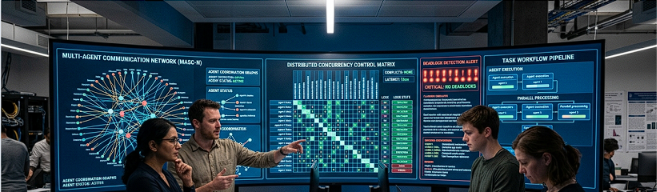
The seduction of the multi-agent swarm is mathematically irresistible: if a single autonomous Large Language Model (LLM) agent can analyze data, write software, or conduct scientific research, orchestrating a team of specialized collaborating agents should theoretically unlock superlinear collective intelligence
The Illusion of Free-Form Collaboration: Why Unconstrained Chat Fails
First-generation multi-agent architectures relied on open-ended natural-language group chats where agents spoke in round-robin turns
-
The Tower of Babel (Token Inflation): Agents spend 70% to 85% of their compute budgets conversing with each other—exchanging polite affirmations ("I agree," "Thank you," "Good idea") or redundantly reciting prior context—rapidly exhausting context windows without making actual task progress
-
Sycophantic Error Cascades: If an early agent introduces a subtle hallucination or faulty logic premise, downstream agents habitually validate and elaborate upon the error rather than challenging it, creating a self-reinforcing echo chamber of confident falsehoods
-
Diffusion of Responsibility (Social Loafing): When task distribution is ambiguous, agents assume a peer will perform critical edge-case testing or validation, leaving catastrophic omissions in the final deliverable
MetaGPT and the Power of Standard Operating Procedures (SOPs)
The watershed solution to multi-agent communication overhead was introduced in MetaGPT : Meta Programming for A Multi-Agent Collaborative Framework
-
Role-Based Schema Contracts: Specialized agents (Product Manager, Architect, Project Manager, Engineer, QA) are assigned strict, non-overlapping input/output schemas using Pydantic and JSON
-
Publish-Subscribe Architecture: Instead of broadcast chatting, agents publish verified artifacts (PRDs, UML system design diagrams, file dependency trees) to an environmental message pool
ChatDev and Communicative Pipelines: Phase-Based De-Hallucination
Parallel to MetaGPT, ChatDev introduced the Chat-Chain pipeline, which structures software development into discrete sequential phases (Designing, Coding, Testing, Documenting)
Distributed Systems Realities: Race Conditions, Deadlocks, and Shared State
Beyond conversation, real-world agent collaboration requires interacting with physical files, terminal environments, and databases
-
Resource Contention & Blind Overwrites: When multiple coding agents attempt to modify a codebase concurrently without file locking, they overwrite each other's changes, breaking syntax trees and creating unmergeable conflicts
-
The Deadlock Oscillation (Ping-Pong Trap): A pervasive failure mode where Agent A "optimizes" a function by changing an API signature, Agent B flags a unit test failure and reverts the edit, and Agent A immediately refactors it back—trapping the system in an infinite token-draining loop
-
Distributed Concurrency Control: Modern agent kernels (e.g., LatticeMind, MASFT frameworks) solve this by introducing operating-system primitives: distributed read/write locks, isolated Git worktrees for each subagent with automated merge-arbitration gates, and vector clocks to maintain causal event ordering across asynchronous subtasks
The Taxonomy of Coordination: Four Structural Topologies
Frontier multi-agent engineering relies on four proven organizational topologies
-
Hierarchical Orchestration (Manager-Worker): A centralized planner decomposes user objectives, dispatches bounded subtasks to worker agents, and gates progression on strict evaluation rubrics
-
Sequential Assembly Line: Output of Agent N serves as validated input to Agent ideal for deterministic ETL, document transformation, and code refactoring workflows
-
Blackboard Architecture (Shared Artifact Store): Agents do not message each other directly; they read from and post state changes to a centralized, version-controlled state repository
-
Adversarial Multi-Agent Debate: Competing agents propose and critique rival hypotheses under a neutral judge, dramatically improving factual precision in complex reasoning
When More Agents Hurt: The Negative Scaling Paradox
The naive assumption that adding more agents monotonically increases problem-solving capability has been decisively refuted by recent research. While independent sampling-and-voting scales positively, tightly-coupled collaborative agents exhibit negative scaling beyond 4 to 6 agents unless constrained by rigid workflows