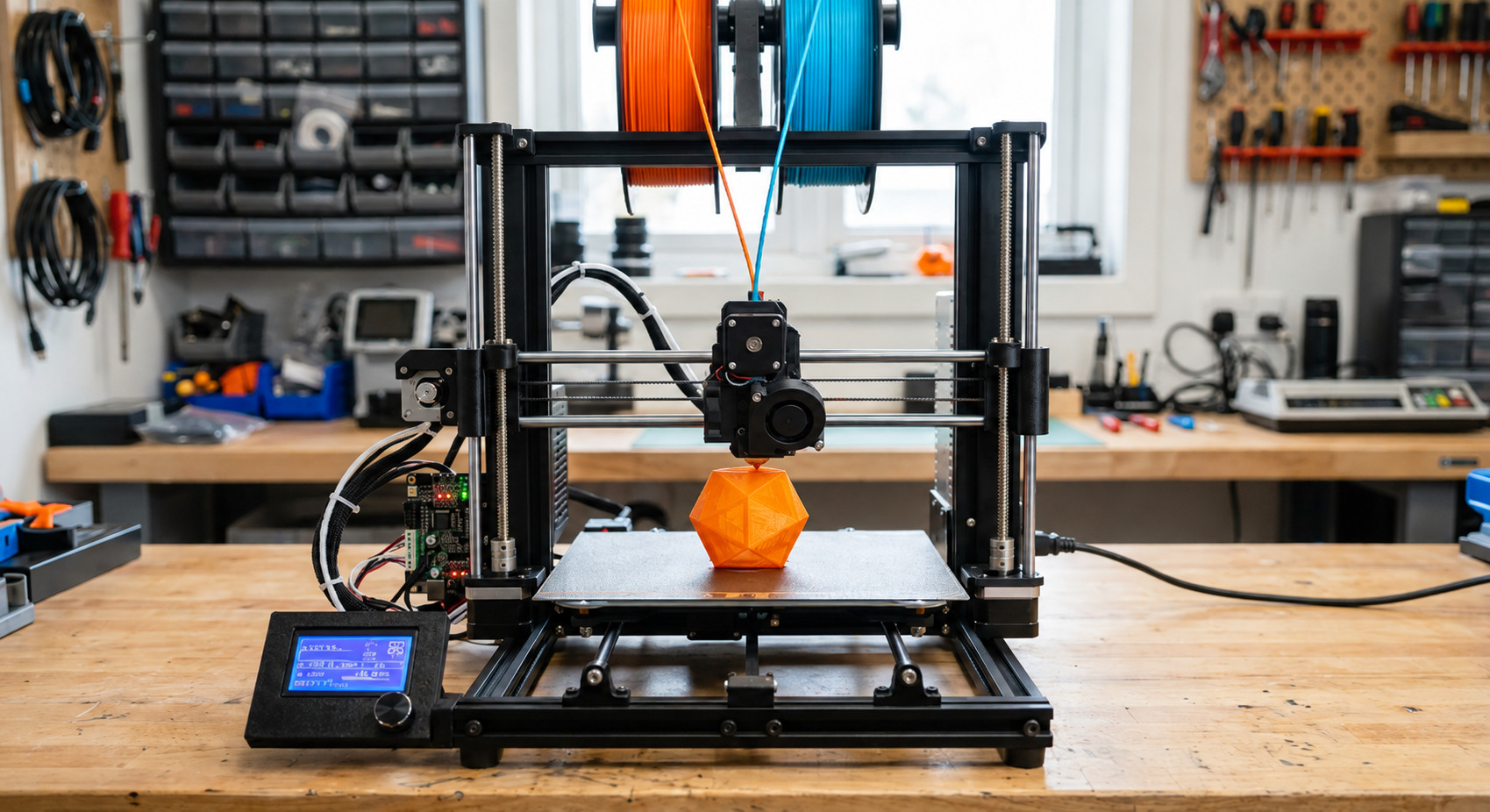
Every Indian home has a drawer of small broken things - the plastic knob from a mixer-grinder, a bracket from a curtain rod, a shelf clip from a fridge that no service centre stocks anymore. A 3D printer can make most of these in under an hour. The question is whether that is worth ₹20,000 or more to an ordinary household.
What has actually changed
Until a few years ago, a home printer usually meant a kit. You assembled it, levelled the bed by hand, and spent weekends working out why the first layer would not stick. Newer machines from Bambu Lab, Creality and others arrive largely assembled, calibrate themselves and print several times faster. Makers call this plug-and-play, which is marketing language, though reviewers generally agree the setup effort has dropped.
Prices in Indian retailer listings run from about ₹14,000 for basic models to ₹40,000 or more for bundles with multi-colour add-ons. The same printer can differ by thousands of rupees between sellers.
What it costs to keep running
The printer is only the first bill. PLA, the standard beginner plastic, sells for roughly ₹1,000 to ₹1,500 per kg from established brands in Indian listings. A 100 g part therefore uses ₹100 to ₹150 of material. One Indian estimate puts electricity at around ₹7 a unit, so a five-hour print on a 200-watt machine adds about ₹7. Failed prints add more, and beginners should expect several.
Compare that with sending a file to a print service. One Indian service lists FDM PLA from about ₹6 a gram, which makes the same 100 g part ₹600. Owning a printer wins only if you print often.
The bottleneck is the file, not the machine
A printer needs a 3D model. Free libraries such as Printables and Thingiverse cover popular items, but your specific fridge clip is unlikely to be there. Making it means learning CAD software and measuring the original with calipers. That skill, more than the hardware, separates households that use a printer weekly from those where it ends up on a shelf.
Material has limits too. PLA starts to soften at roughly 60°C, so a part near a gas stove or inside a parked car can warp.
The air in the room
Desktop printers release ultrafine particles and volatile organic compounds as plastic melts. PLA emits considerably fewer particles than ABS, though studies disagree on how large the gap is. It is not emission-free, and no exposure limit has been published for desktop printer emissions.
Room size matters. In one office study, a 165-minute print in a large, ventilated office did not significantly raise particle or VOC levels. In a small, unventilated room the levels rose measurably and were still detectable 20 hours later.
That is relevant to Indian flats, where a printer often ends up in a bedroom or study with the door shut and the AC running. The practical advice from the research is modest: print PLA, keep the machine away from where you sleep or sit, and ventilate the room.
Verdict
For households that repair things, students building projects, or hobbyists willing to learn CAD, a printer is now a reasonable purchase. For a family that expects it to simply print whatever is needed, it will probably become an expensive shelf ornament. A sensible test before buying is to list what you would print over the next three months and price those parts at a print service.
The machines have become easier to use. The design skills, running costs and air-quality question have not gone away.