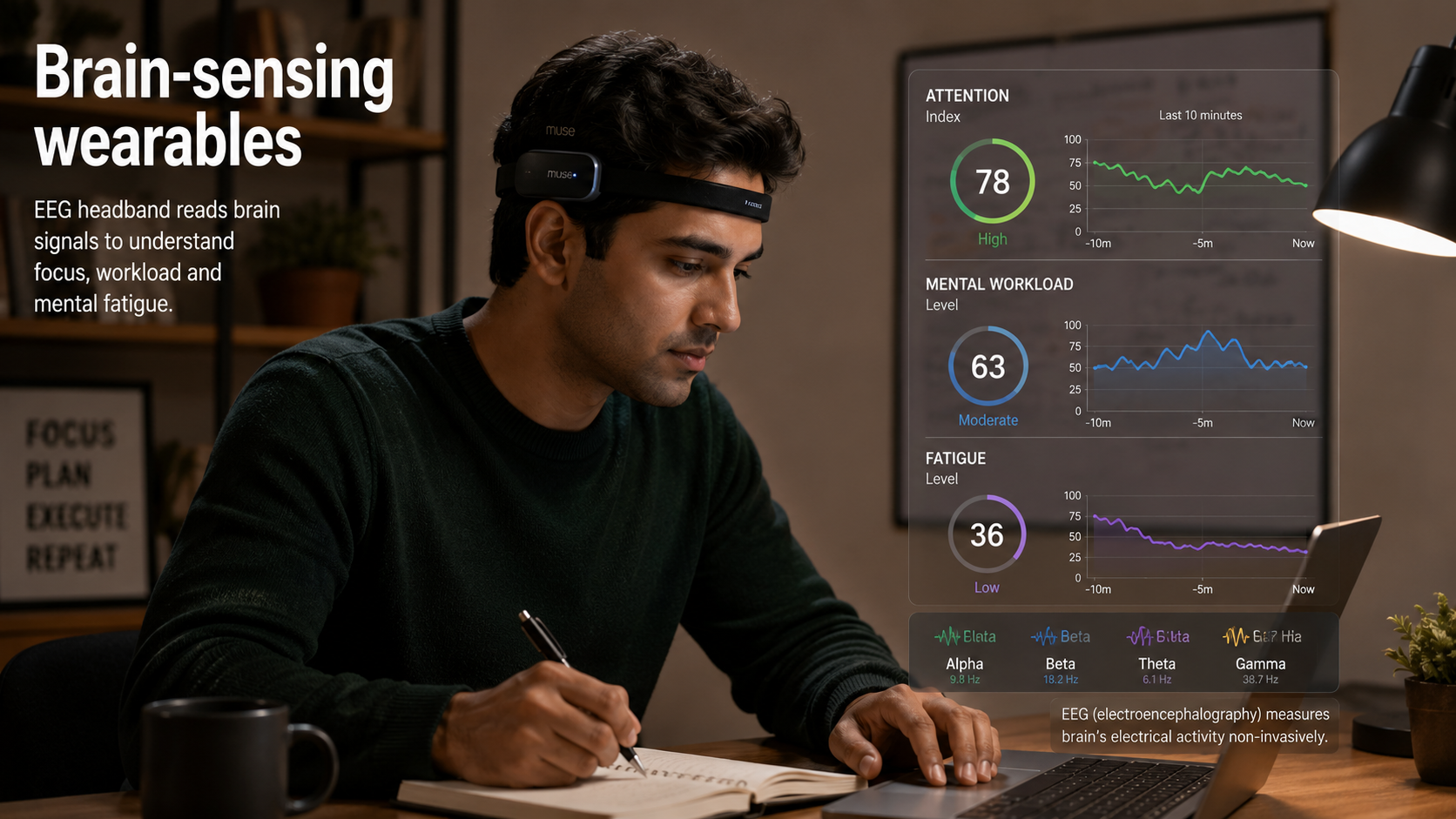
Your future headphones may notice that your concentration has collapsed before you consciously admit it. What they probably will not know is whether you are tired, bored, mentally overloaded or simply contemplating lunch with unusual intensity.
That distinction matters, because “mind-reading wearable” has become convenient shorthand for a rapidly improving field of neurotechnology that is considerably less magical — and potentially more useful — than the phrase suggests.
Researchers are shrinking brain-sensing equipment into headbands, ear-worn devices and other relatively unobtrusive formats. Combine those sensors with machine learning, and software can sometimes identify patterns associated with attention, fatigue or cognitive workload. It is not telepathy. It is sophisticated signal interpretation.
What EEG actually measures
The most familiar technology is electroencephalography, or EEG. Neurons communicate through electrical and chemical activity, and electrodes placed around the head can detect tiny voltage changes produced by large populations of those neurons working together.
Traditional EEG systems are unmistakably medical: multiple electrodes, wires, careful positioning and sometimes conductive gel. Wearable versions attempt to make the same fundamental measurement more practical through dry electrodes, fewer sensors and increasingly compact electronics.
What emerges from the device is not a neat transcript of thought. There is no data stream reading, “Thinking about pizza; pretending to study; now wondering whether anyone noticed.”
Instead, algorithms examine complex electrical patterns and try to infer broader states. Researchers may look at how activity changes when someone becomes drowsy, switches tasks or experiences different levels of mental workload.
That is a much harder problem than reading text from a screen, because the screen is noisy, biological and inconveniently attached to a different human every time.
Could it actually improve concentration?
Potentially, and this is where the technology becomes more interesting than the “mind-reading” headline.
Suppose a wearable can estimate when sustained attention begins to deteriorate during study or training. Software could respond by adjusting the task, recommending a break or providing neurofeedback designed to help the user recognise and eventually regulate their own cognitive state.
Similar ideas could be useful in gaming, meditation, safety-critical jobs and education. A system might detect increasing fatigue in an operator, recognise that a learner is becoming overloaded or adapt a game when a player is no longer meaningfully challenged.
None of this requires the computer to know exactly what someone is thinking. It only needs a useful estimate of what kind of cognitive state they are in.
That sounds less dramatic than telepathy, but it is also considerably more achievable.
There is no productivity gauge inside your skull
This is where scepticism becomes important.
There is no universal brain signal labelled PRODUCTIVITY: 83%. EEG measurements are affected by movement, sensor placement, individual physiology and environmental noise. Consumer devices typically have fewer electrodes than research systems, while real-world conditions are far messier than laboratories.
Even a correctly identified neural pattern can be ambiguous. Someone who appears disengaged could be distracted, deeply reflective or simply processing a difficult problem more slowly.
For that reason, using neurotechnology to assist an individual is one thing; using it to judge employees, students or customers is much more troubling.
The world's offices already contain enough questionable performance metrics without adding “Tuesday afternoon alpha-wave enthusiasm” to the dashboard.
Brain data raises unusually personal privacy questions
Neurotechnology also creates a category of data that deserves more caution than ordinary fitness tracking.
A smartwatch may reveal when you slept, exercised or experienced an elevated heart rate. Neural measurements could eventually enable inferences about cognitive or emotional states, particularly as algorithms improve and datasets accumulate.
That possibility has attracted serious international attention. UNESCO adopted a global recommendation on the ethics of neurotechnology in 2025, while the UN Scientific Advisory Board has highlighted privacy, consent, security, inequality and human agency as brain-computer technologies move beyond medicine.
The uncomfortable question is therefore not only what today's headset can infer. It is what tomorrow's software might discover by reanalysing neural data collected today.
The useful future may look surprisingly ordinary
The first broadly useful brain-sensing wearables are unlikely to extract secret thoughts. They are more plausibly devices that recognise fatigue, support meditation, adapt training or help users understand when their attention is deteriorating.
That may sound modest beside the phrase “mind reading”, but technology often becomes transformative precisely when the magic disappears and the useful feature becomes mundane.
Your headphones may never discover your deepest secrets. If they can reliably recognise that you have reread the same paragraph four times without absorbing it, however, they may already know something worth telling you.