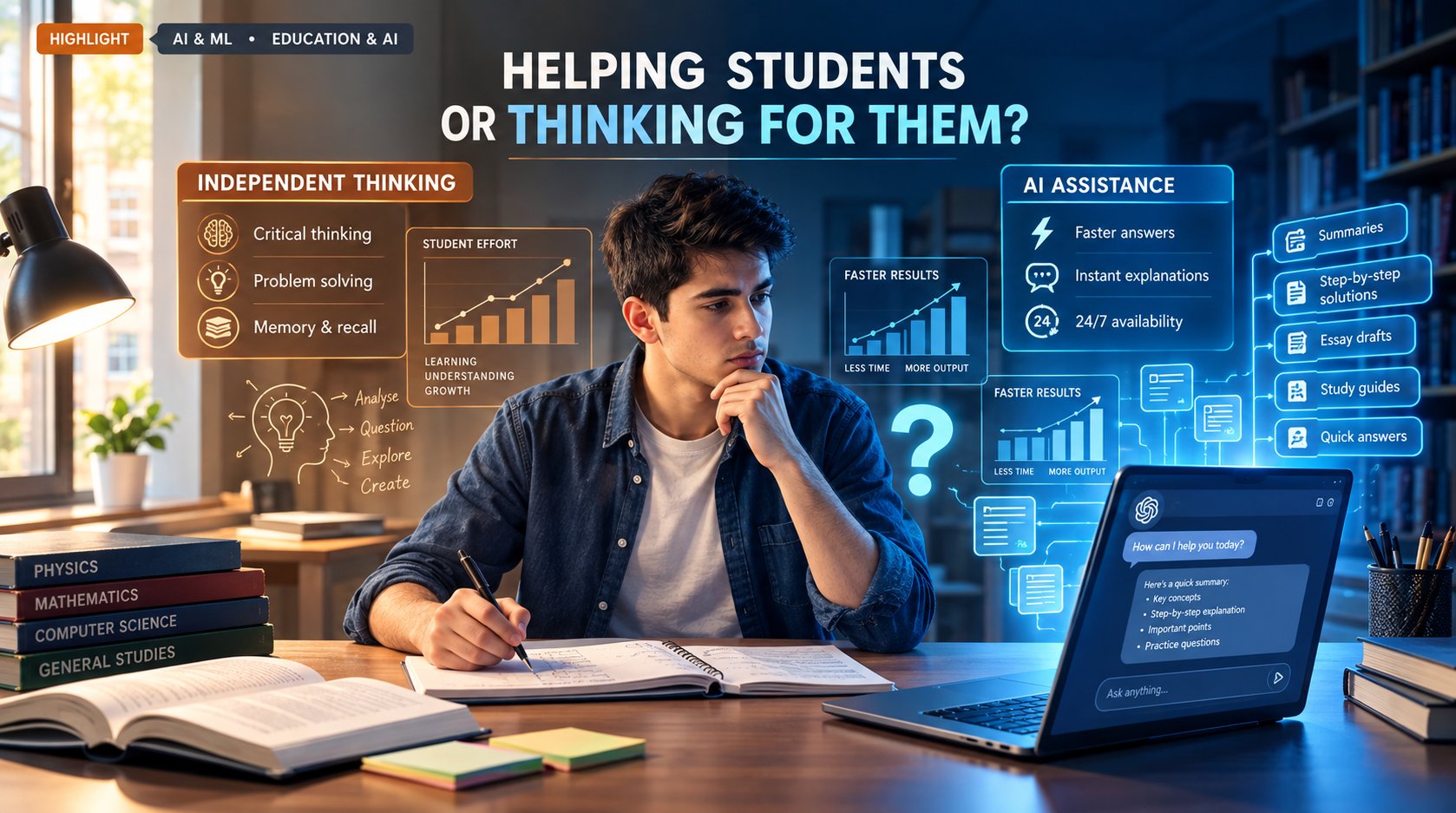
The debate isn't really about whether students use AI. It's about what happens to their thinking in the moments they stop noticing they're using it.
In the summer of 2025, researchers at the MIT Media Lab strapped EEG headsets onto 54 students and had them write SAT-style essays under three conditions: using ChatGPT, using Google search, or using nothing but their own heads. Their paper, “Your Brain on ChatGPT,” found what they called “cognitive debt.”
The ChatGPT group showed the weakest brain connectivity of the three, struggled to quote their own essays back afterwards, and reported feeling the least ownership over what they’d written. Months later, when some of them tried writing unaided, the gap hadn’t closed.
That small study became the opening line of a much bigger argument now playing out in lecture halls, hostel WhatsApp groups and faculty meetings everywhere: are students getting sharper with AI, or just getting used to not thinking?
The numbers say “used to it” is putting it mildly
OpenAI has said India is now home to the largest population of student ChatGPT users in the world, with close to half of the platform’s Indian users under the age of 24.
A University of Delhi survey of Library and Information Science students found two-thirds would recommend ChatGPT for academic work, citing its round-the-clock availability as the biggest draw.
Surveys of students elsewhere show a similar shape: almost everyone who uses AI at all uses it for coursework, and most describe themselves as satisfied or very satisfied with it.
This isn’t a fringe habit anymore. For a large share of today’s students, it’s simply how studying works.
Using AI and depending on it aren’t the same thing — but the line blurs fast
Researchers are careful to separate using a tool from depending on it, though in practice the two slide into each other quickly.
A 2025 study of 580 Chinese university students, published in Acta Psychologica, found that higher AI dependence was linked to lower critical thinking scores — and traced part of that effect to something specific: cognitive fatigue.
Students who leaned on AI heavily weren’t becoming less capable in some vague, general sense. They were tiring out mentally faster, and that fatigue, not the AI itself, appeared to be doing some of the damage.
Students already sense the risk — they just don’t apply it to themselves
What makes dependence hard to catch is that it rarely feels like laziness from the inside.
A RAND survey of nearly 1,200 American students found that by December 2025, 67% agreed that heavier AI use among students harms critical thinking, up more than ten points from ten months earlier.
Students weren’t in denial about the danger in the abstract. Most simply didn’t count their own everyday use — clarifying a concept, checking a proof, restructuring a paragraph — as the harmful kind, even when it quietly was.
The one factor that seems to matter: how literate students are about the tool
The Acta Psychologica study also found something more hopeful.
AI literacy — understanding roughly how the tool works, where it tends to get things wrong, and when to double-check it — acted as a buffer, weakening the link between dependence and declining critical thinking.
In other words, the damage isn’t AI use itself; it’s uninformed AI use.
A student who treats an AI’s answer as a first draft to interrogate ends up in a different place, cognitively, than one who treats it as a finished answer to submit.
So, are students too dependent?
The honest answer is: some are, on some tasks, some of the time — and most students, including the ones who tell researchers they’re worried, haven’t fully worked out where their own line sits yet.
The MIT study’s most quietly important detail wasn’t simply the weaker brain activity. It was that participants who wrote with ChatGPT first and then tried writing alone still underperformed the group that had never used it at all.
Dependence, once it sets in, doesn’t simply disappear the moment the tool is taken away — which is exactly why the question is worth asking before it sets in, not after.