Many stories about AI discovering something new are hard to check from the outside. This one comes with a proof that a computer has checked line by line. Between October 1 and 3, James Chang ran a team of AI agents inside OpenAI's new Dots product. They improved a bound in a small corner of mathematics. The result is modest. How it was checked is the interesting part.
What the Agents Actually Proved
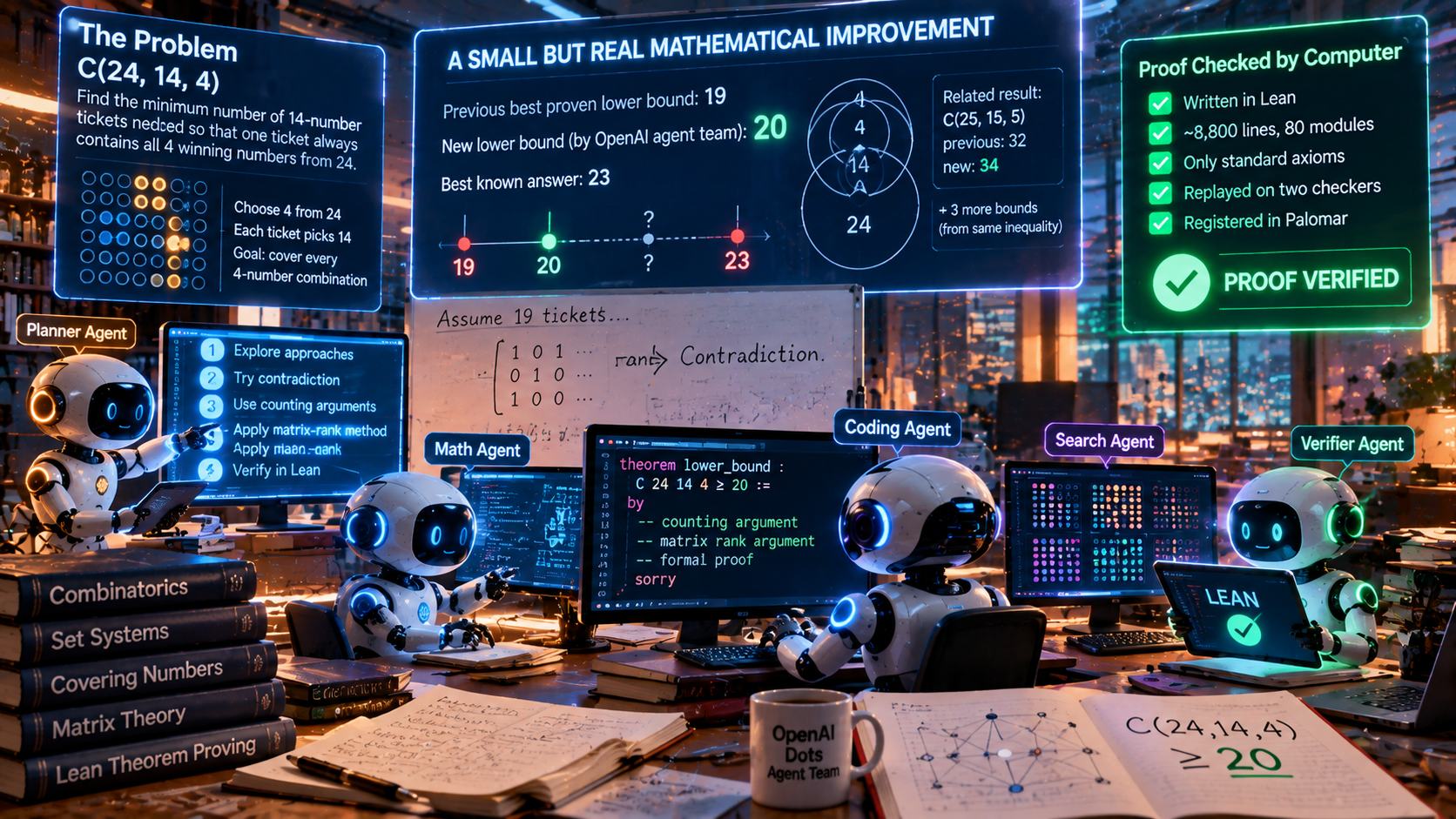
Picture a lottery that draws 4 numbers out of 24. Each ticket lets you pick 14 numbers. How many tickets do you need so that one ticket always contains all four winning numbers? Mathematicians call this a covering problem and write it as C(24,14,4). The best known answer is 23 tickets. The best proven minimum used to be 19. Chang's proof raises it to 20. So the true answer is still somewhere from 20 to 23.
The old bound was not a famous result. It follows from a 1979 result by Mills and a 1964 inequality by Schönheim, and it sits in a public table of covering numbers. The agents were chasing a different question and found this one along the way. They assumed 19 tickets could work and hunted for a contradiction. Counting arguments and a matrix-rank argument gave them one. Different agents handled the mathematics, the Lean code, computer searches and adversarial review, and they checked one another's work.
The new bound also spreads. Using the same inequality, it lifts a related bound, C(25,15,5), from 32 to 34. Three further bounds follow on paper, but those three are not formalized in Lean.
Why a Proof Checker Changes the Story
Chang wrote the proof in Lean, a language where a small program called a kernel checks every step. If the kernel accepts the proof, the theorem is true, no matter who or what wrote it. You do not have to trust the agents.
You do have to trust two things. First, that the statement matches the real problem. That statement is only a few lines long and uses the standard textbook definition. Second, that the checker works. Here the proof was also replayed on two separate checkers. It was registered in Palomar, a public registry of Lean-verified results. It uses only Lean's three standard axioms, and it runs to about 8,800 lines across 80 modules.
Two things are not verified. No mathematician has reviewed the proof yet, and Chang says so himself. And Lean confirms the theorem, not that the written explanation is right. The explainer pages were also written by AI and may contain mistakes. Chang's repository also keeps an agent's own successful build separate from an independent rebuild.
A Product, Not a Benchmark
Dots launched on September 29. OpenAI describes them as always-on agents powered by GPT-6 Astra, each with its own cloud computer. They are rolling out to Pro and Business Premium users in eligible markets. Chang's team had seven agents: one coordinator and six Astra research agents. OpenAI says it envisions "teams of dots" working together.
This was one run, not a test of Dots. A human picked the problem, steered the work and decided what to chase next. The agents did the mathematics and wrote the Lean code. So the result shows what is possible, not how often it works. Reports based on Geekbench results suggest each dot runs on a small cloud machine with about nine processor cores and 10GB of memory. OpenAI has not confirmed this, and Chang does not say what hardware his team used.
What Could Come Next
In the near term, expect review. Chang has asked mathematicians to check the proof. His campaign continues, now aimed at whether a 20-ticket covering exists. That question is still open, and a failed search would prove nothing.
The bigger shift is the habit. Palomar's registry lists dozens of Lean-verified results from the past few days alone. If agents can produce proofs a computer can check, the bottleneck moves to what humans must judge: is the statement the right one, and does the result matter?
That second question is the honest limit here. Raising a bound by one in a niche table is not a breakthrough. Whether agent teams can do this for problems people care about is a prediction, not a finding.