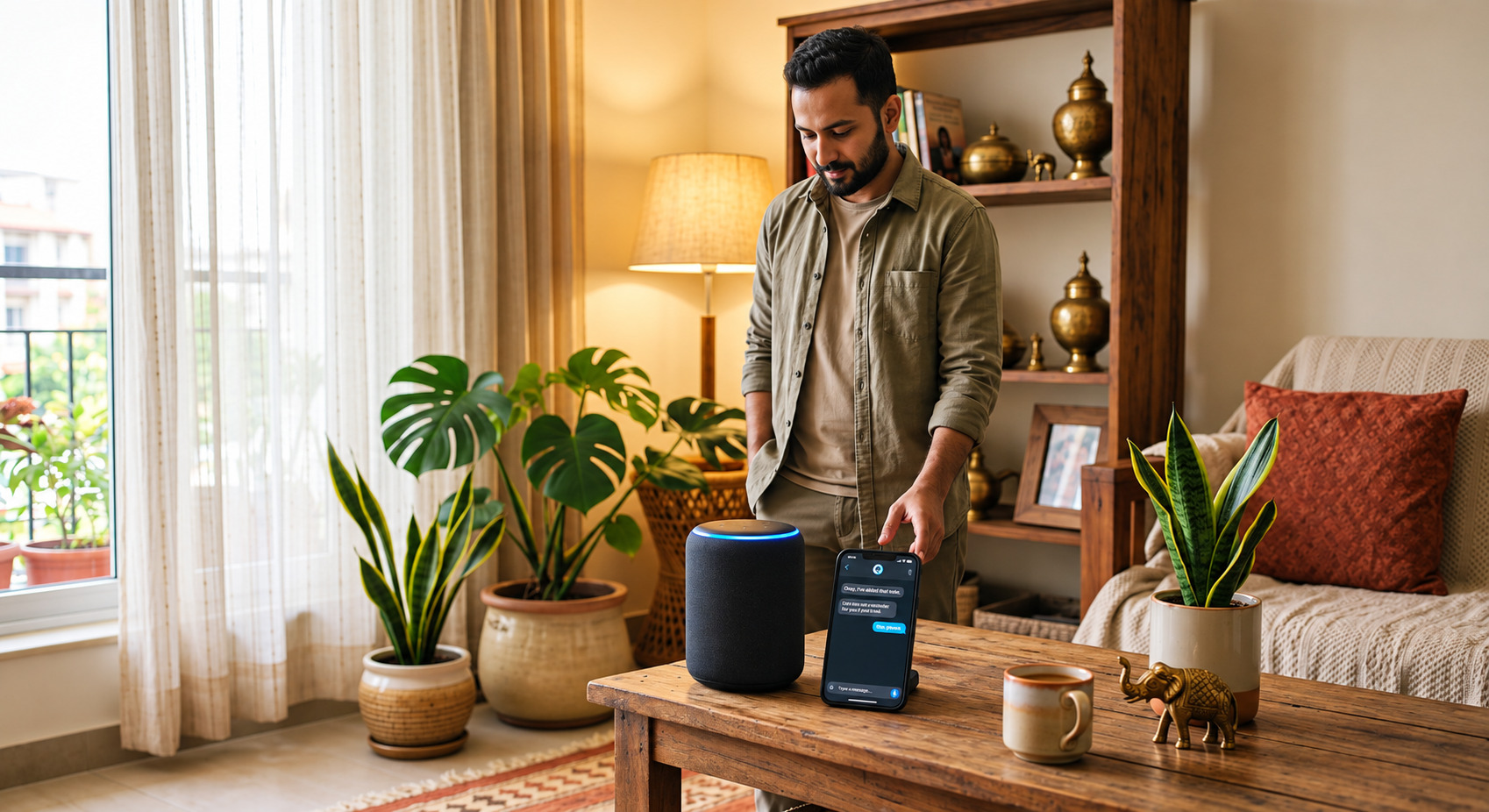
Ask old Alexa to turn off the living room lights and then play something calmer, and it would hear that second sentence as a brand new request — no memory of what "something calmer" was supposed to follow. That single limitation is basically what a decade of voice assistant complaints boiled down to. Alexa+, which reached India on September 16, 2026, is Amazon's attempt to finally fix it.
What's actually different from old Alexa
The old Alexa ran on intent matching — it heard your sentence, tried to slot it into one of a few thousand pre-built commands, and executed that single action. No memory between requests, no real understanding of context. Alexa+ runs on a large language model instead (Amazon's own Nova model, in this case), which is why it can hold a thread across a conversation. Ask it to dim the lights, then say "make it a little darker," and it knows you're still talking about the lights — you don't have to repeat yourself. Early US reviewers have noted this is genuinely the most noticeable day-to-day change: less repeating yourself, less rephrasing until the assistant "gets it."
One instruction, several devices
The second big shift is something Amazon calls "experts" — essentially specialised systems, each wired into a different service or device category, that Alexa+ can call on to actually complete a task rather than just answer a question. Say "move the music to the bedroom speaker" or "put the cricket match on the living room TV," and Alexa+ is meant to figure out which device and which action that maps to without you specifying model names or exact phrasing. It's the difference between an assistant that understands one command at a time and one that can coordinate across a smart home the way a person would, glancing between the fridge, the TV, and the lights instead of treating each as its own island.
Talking to Indian services
In India specifically, Alexa+ works in English, Hindi, and Hinglish, and Amazon has hooked it into apps people already use daily — Swiggy for food, MakeMyTrip for travel, JioSaavn for music, District and EazyDiner for going out, plus Amazon's own quick-commerce arm for groceries. The idea is that "order paneer and remind me to call the plumber" becomes one sentence instead of two separate app-opening chores. Restaurant bookings and full trip planning are billed as coming later, not live yet — worth knowing before you expect too much on day one.
Where the demo and daily life don't quite match
Here's the part worth being upfront about. Amazon has talked about "agentic" abilities since the very first Alexa+ announcement — the assistant finding a repair technician, booking the appointment, and confirming it, all without you checking in. In practice, US reviewers who've lived with it for a few months have been more mixed on this exact feature, describing the autonomous booking and ordering as the one part that still falls short of the pitch, even while praising the conversational memory as a real improvement. That gap — between "it remembers what I said" and "it can be trusted to book things on its own" — is really the whole story of whether Alexa+ works, and it's the one thing a press release can't tell you.
Does this finally deliver on the old promise?
Voice assistants have always been sold on the idea of a genuine conversation, and Alexa+ is the first version that actually holds one instead of just answering isolated questions. That part looks real. Whether it can be trusted to reliably act on your behalf — order the right thing, book the right slot, without supervision — is still being tested in public, by people using it every day rather than watching it on a stage. India getting the rollout now means that answer is about to get a much larger sample size.