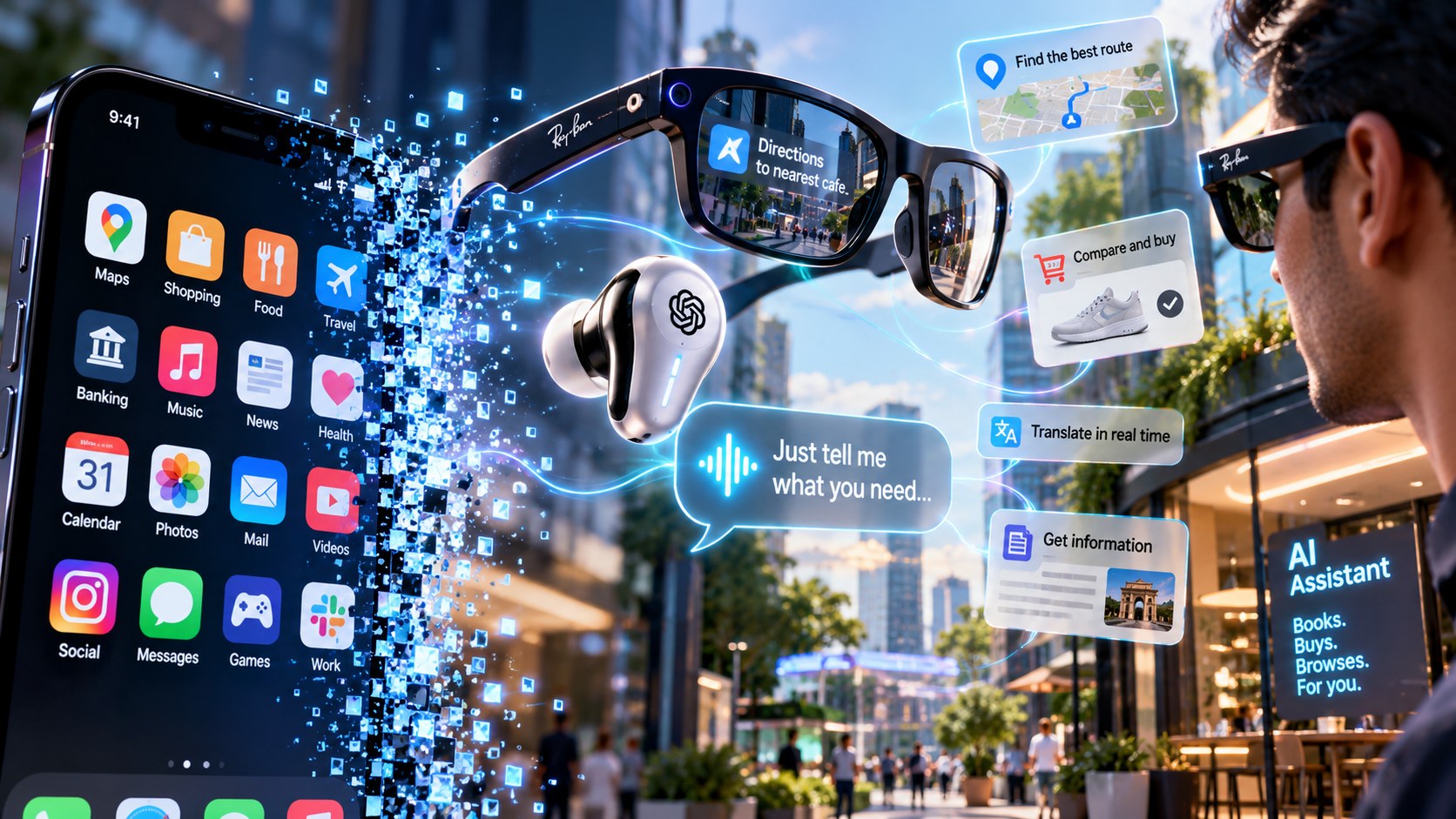
For 15 years, using a computer has meant the same thing. Tap an icon. Open an app. Click around until you find what you need. Some big companies now want to skip all that. Instead of opening a maps app, you just ask an assistant to get you there. Instead of browsing a shopping app, you tell an AI what you want, and it buys it. The app itself starts to matter less. One AI layer just does the work for you.
The devices: one real hit, one big delay
Let's start with what's actually working. Meta's Ray-Ban smart glasses are a real hit. Meta makes them with EssilorLuxottica, the company behind Ray-Ban. In 2025, they sold more than 7 million pairs. That's about three times what they sold the year before. Meta wants to sell 10 million pairs in 2026. The glasses use Meta AI. You can ask them a question, get something translated on the spot, or snap a photo, all without touching your phone.
OpenAI's device is a different story. Sam Altman is building it with Jony Ive, the designer who helped create the iPhone. OpenAI bought Ive's company, io, for about $6.5 billion in 2025. At first, OpenAI talked about launching this device sometime in 2026. It was supposed to have no screen at all, just voice. But that didn't happen. Court papers from a lawsuit showed that OpenAI now won't ship the device before the end of February 2027. OpenAI also dropped the name "io" completely. Since this comes from a legal filing and not a press release, it's one of the few facts about this device we can actually trust.
This isn't the first time someone has tried this. The Humane AI Pin came out in 2024 and flopped, and HP bought what was left of it. The Rabbit R1 had a short burst of hype that faded fast. Both failed for the same reason: the AI wasn't good enough yet, and neither gadget gave people a real reason to carry something new next to a phone that already does the job.
The other side of the story: a real privacy fight
Meta's sales numbers look great, but they don't tell the whole story. Through 2026, The Verge and other outlets reported people using the glasses to secretly film strangers. The only warning is a small light on the frame, and a cheap trick can turn that light off. UK cinemas started banning the glasses. In the Netherlands, a consumer group asked the EU to ban them entirely in their current form. In the US, at least 12 states already require everyone in a conversation to agree before it gets recorded. In July 2026, Meta pushed out a software update. Now, if someone messes with the privacy light, the camera shuts off for good. California has a bill called SB 1130. It would make it a crime to disable that light at all. As of August 2026, the bill had passed committee, but it wasn't law yet. Selling well and being trusted by the public, it turns out, are two very different things.
The bigger idea: AI that does things, not just talks
The device itself isn't really the point. What matters is what runs on it. For years, an AI assistant could only talk back to you. Now that's changing. OpenAI built something called the Agentic Commerce Protocol. Google has its own version, called the Unified Commerce Protocol. Both let an AI agent search for a product, compare prices, and buy it, sometimes without you ever opening a website. Microsoft, Perplexity, and Google have all added similar shopping tools right inside their chat apps.
This is real, but it's still pretty small. OpenAI says only about 2% of ChatGPT questions are shopping-related. And most of what people call "AI shopping" isn't really automatic. Usually, the AI just suggests something, and you click through to buy it yourself. Buying something start to finish, all inside a chat window, only works with a handful of stores right now. A 2026 survey found that only 17% of people felt okay letting AI finish a purchase completely on its own.
Why this matters: someone still owns the front door
If people start using AI to search, compare, and buy things, that changes who competes for attention. Companies used to fight for a spot on your phone's home screen. Now they have to fight to get picked by an AI they don't control. Some businesses are already rewriting their product pages just so AI can read and compare them more easily. People call this AI-readable commerce. Whoever owns that AI, whether it's OpenAI, Google, or whoever runs your phone's operating system, ends up holding the same kind of power app stores used to have.
That's really why this device race matters. The software does the actual work, but a phone's built-in assistant only goes as far as Apple or Google allows. A separate device, like glasses or earbuds, gives a company its own direct line to you that nobody else can block.
What's likely soon, and what's still just talk
In the near future, expect smart glasses to keep growing. They already have real sales and real money behind them. But they also have a real fight ahead over privacy laws, and that fight will shape how they're allowed to work. AI shopping will probably keep growing too, but slowly, and mostly inside apps people already use, like ChatGPT and Google. It won't replace those apps overnight. People don't change their habits that fast.
The bigger idea, apps disappearing completely and one AI layer taking over everything, is still just a guess. Some analysts think AI-driven shopping could make up 10% of all sales within three to five years. But that's a prediction, not something that's already happened. For now, apps aren't going away. They're just quietly becoming the thing that AI talks to behind the scenes.