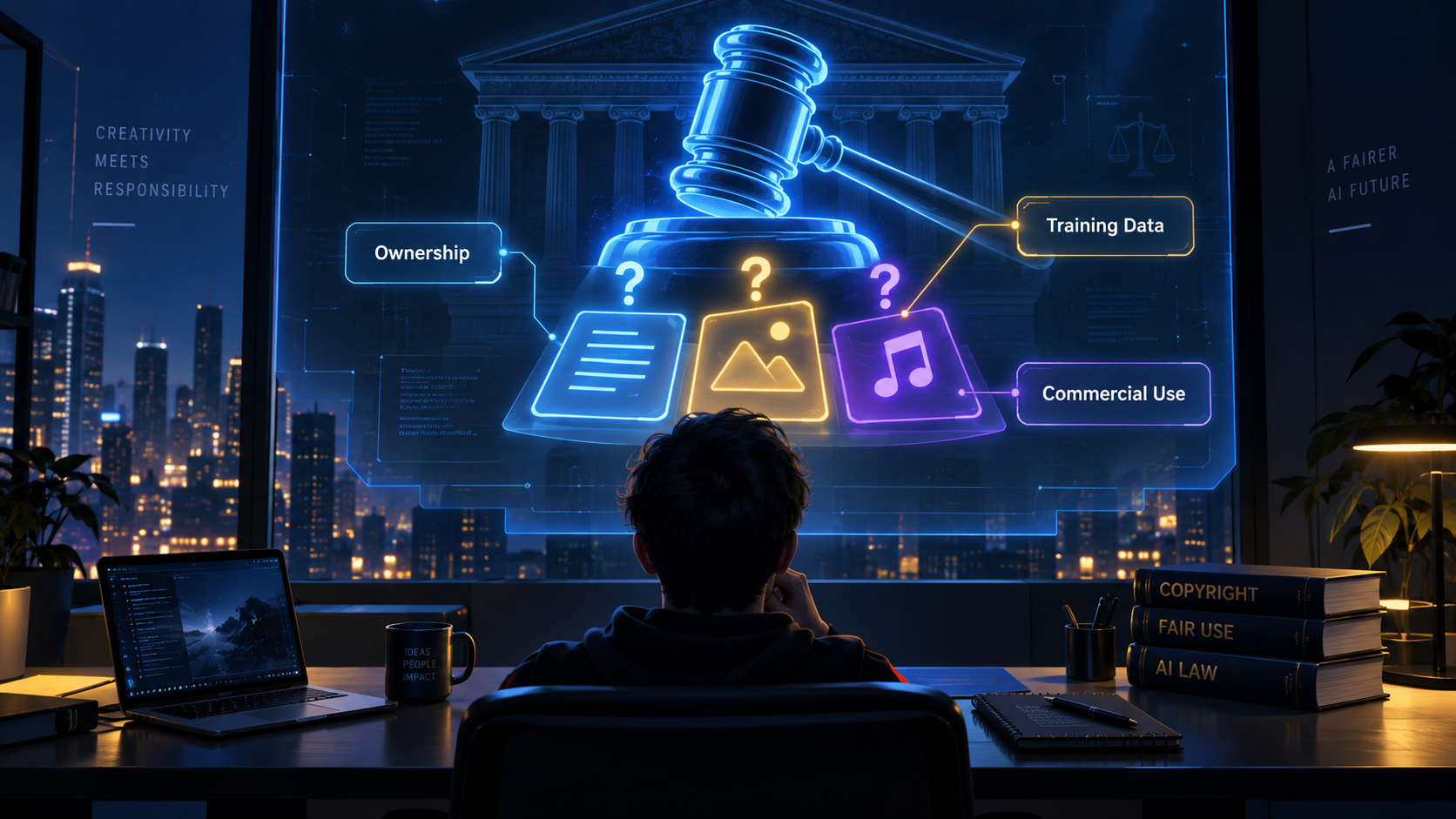
In March 2026, the Supreme Court quietly closed a four-year legal fight. It didn't say much. It just refused to hear a case called Thaler v. Perlmutter, about whether an AI system could be listed as the sole author of a piece of art. That refusal left the old ruling in place: AI can't hold a copyright. Simple as that. But it's not actually a clean answer, because almost nobody asks AI to make something with zero human involvement. Most people type a prompt, look at what comes out, then edit it, pick parts of it, or build on it. That's where things get messy.
Using AI as a tool vs. asking it to make something for you
This is really the core issue, and courts have been fairly consistent here. Say you use AI to fix grammar in something you already wrote. Or you get a rough sketch from AI, then repaint most of it yourself. You're still the author. You can copyright the final piece like normal. But if you type a prompt and just take what comes out, no real changes, you don't own it. You didn't make it. The AI did. And AI can't be an author under US law.
Most real fights happen in between those two extremes. Courts have said a longer, more detailed prompt doesn't automatically make you the author. What matters more is what you did after the AI gave you something. Did you keep it as is? Cut half of it? Rework it? Add your own stuff? The more you can point to real changes you made, the stronger your claim.
The training data fight is a different problem
Owning what you make with AI is one issue. Whether the AI company was even allowed to train on copyrighted books, articles, or songs in the first place is a totally separate one. Courts are still working through that case by case.
Two rulings from 2025 shaped where things stand now. In Bartz v. Anthropic, a court said training an AI model on books Anthropic had legally bought was fair use. But it also said keeping pirated books, ones Anthropic downloaded instead of paid for, wasn't okay. That case ended with a $1.5 billion settlement, approved in July 2026. It's the biggest copyright class-action settlement ever.
Kadrey v. Meta landed in a similar place on the training question, but it's still going through the courts over how Meta got its training data to begin with. So here's the pattern so far: training on stuff you paid for tends to hold up in court. Training on pirated stuff doesn't, no matter how useful or "transformative" the training was.
Ownership and originality are two different questions
Ownership asks: who gets the copyright? Originality asks: does this even qualify for a copyright at all? AI content can fail the second question before the first one even comes up. If there's no real human creativity behind it, nobody owns it. Not you, not the AI company, nobody.
The Copyright Office treats prompting by itself as too thin to count as real authorship. It's a bit like hiring a painter and describing what you want, that doesn't make you the artist. But editing the output, mixing it with your own work, or making real creative decisions after it's generated? That's what actually gets you closer to owning it.
Using it commercially adds another problem
Even when who owns something is clear, using AI content to make money brings its own risks, especially with music. Some big labels, like Warner and Universal, signed licensing deals with AI music companies instead of waiting on the courts. Sony went the other way. It's still suing AI music tools Suno and Udio, arguing their songs were built on copyrighted recordings. A major ruling is expected sometime in mid-2026.
Until that's settled, selling AI-made music without a clear license is risky. Not because AI itself is the problem, but because nobody's sure yet whether the training data behind that music was legal to use.
Why none of this is actually settled
The Supreme Court's March 2026 decision answered one narrow question: AI alone can't be an author. That's it. It didn't say how much human work is "enough." It didn't touch the legal-vs-pirated training data question. And it said nothing about music, which is being fought over completely separately from books and images.
Sites that track AI copyright lawsuits count well over a hundred active cases in the US alone, as of mid-2026. Different courts, different types of content, different arguments. No single ruling is going to wrap all of this up at once.
So if you're using AI tools for anything commercial, don't wait around for the law to get clear. Keep notes on what you changed, what you added, what you cut. And actually read the licensing terms of whatever AI tool you're using. Right now, those terms matter more than the law does, because the law hasn't caught up yet.