Up to half of the US data center capacity planned for 2026 could be delayed, according to Sightline Climate data reported by Bloomberg in April 2026. The main cause is not a chip shortage. It is a shortage of power equipment, such as transformers, switchgear, and batteries, plus a grid that cannot connect new demand fast enough.
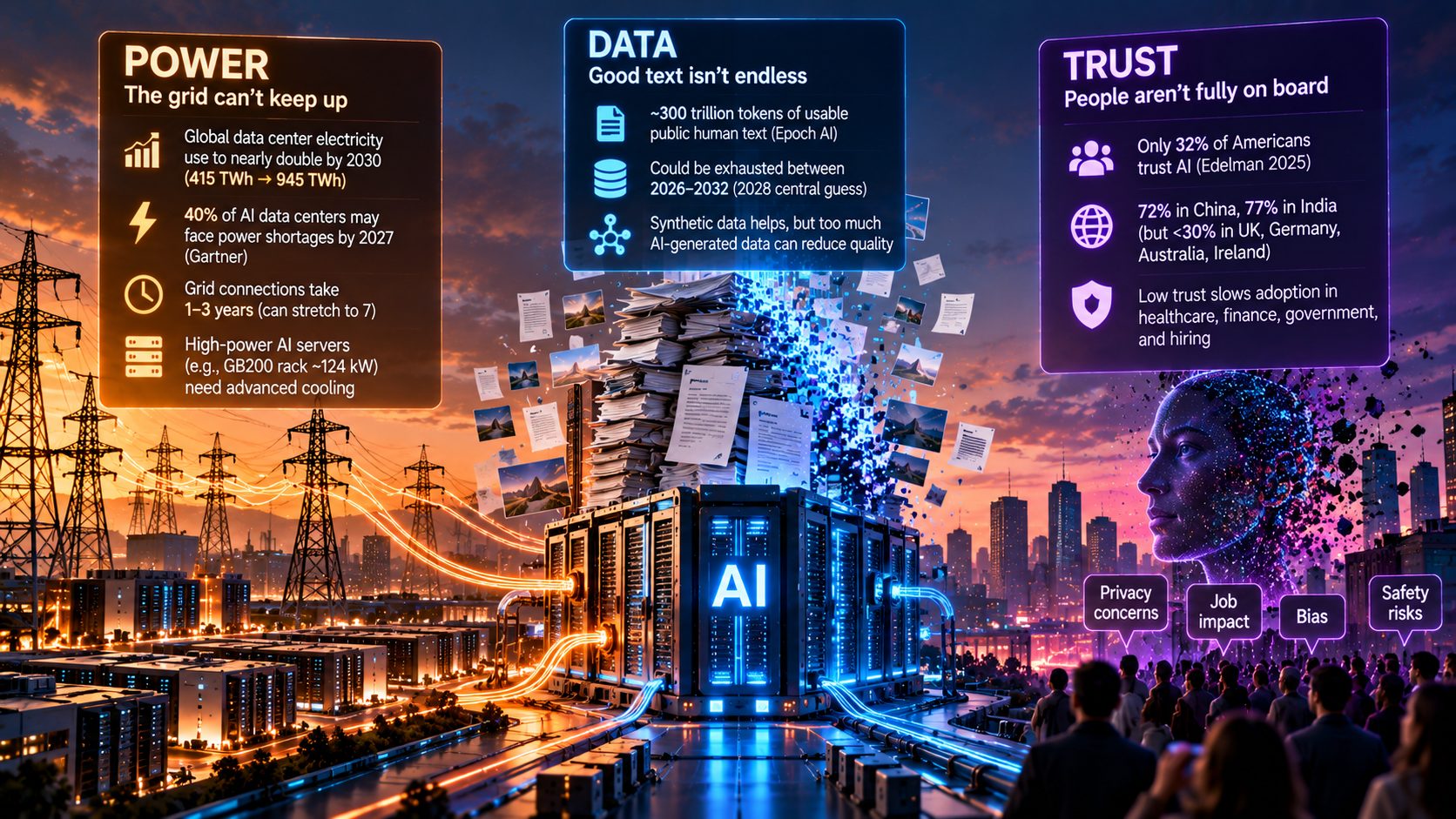
This points to a bigger shift. For years, AI progress meant one question: how smart can the next model get? Now three AI bottlenecks are growing alongside that race. Is there enough electricity? Is there enough good training data? Will people trust AI enough to use it for things that matter? A better algorithm fixes none of them.
Power: The Grid Cannot Keep Up
Energy is the most visible limit. The International Energy Agency (IEA) projects that global data center electricity use will grow from about 415 terawatt-hours in 2024 to about 945 by 2030. That is roughly what Japan uses in a year. The IEA says AI is the biggest driver. Gartner forecast in November 2024 that power shortages would limit 40% of existing AI data centers by 2027. Both are projections, not measured results.
Connecting to the grid is slow. Reuters reported in February 2026 that US connection queues average one to three years, according to the IEA, and can stretch to seven. An Amazon Web Services executive said that in Europe a grid connection can take up to seven years, while building the data center takes about two.
The hardware also needs more power. SemiAnalysis estimates one Nvidia GB200 NVL72 rack draws about 124 kilowatts in total. That is around three times an air-cooled rack of H100 servers. These racks need liquid cooling, which many older buildings cannot support.
Not everyone accepts the "half are cancelled" headline. SemiAnalysis says most of the flagged capacity was still at the announcement stage. Sightline's own tracker counted only nine cancellations. So delays are far more common than cancellations. Sightline also says only about 3% of 2026 projects plan to rely solely on their own power, so most still depend on the grid.
Data: Good Text Is Not Endless
The second limit is quieter. Epoch AI, a research group that tracks AI training trends, estimates there are about 300 trillion tokens of usable public human text. A token is a small chunk of text, roughly a word. In its 2024 paper, Epoch said this stock could be fully used between 2026 and 2032, with 2028 as its central guess. This is a forecast, and it depends on how fast companies keep scaling.
The main response is synthetic data, which is text that an AI model writes to train the next one. Microsoft's Phi-4 model used it, and Microsoft says it is not a cheap substitute for real data. But it has a catch. A 2024 study in Nature found that training models on AI-made data without care makes them lose variety and quality over generations. It is like photocopying a photocopy. The authors say filtering matters, and so does keeping real human data in the mix. That limits how much synthetic data alone can solve.
Trust: The Bottleneck That Is Not Technical
The third limit is whether people will let AI do things that matter. Edelman's 2025 Trust Barometer found that only 32% of Americans trust AI. In China the figure was 72%, and in India it was 77%. The global average was 49%. The UK, Germany, Australia, and Ireland were all under 30%. Edelman's fall 2025 poll again put the US at 32%.
This matters because low trust slows adoption in the places where AI could add the most value, such as healthcare, finance, government, and hiring. Mistakes in those fields are hard to undo, so institutions move slowly. Trust also differs a lot by country. A single global story about AI adoption would be misleading.
What Could Happen Next
These three limits are linked. That is my analysis, not a finding from the sources above. A power-starved data center cannot train a new model, however much data exists. A model trained on thinner or polluted data may make more mistakes, which hurts trust. Low trust can bring pressure for rules that slow new data centers, which makes the power problem worse. It is a loop, not three separate dials.
In the near term, expect energy to stay the most visible limit, because it shows up as delayed projects and higher power bills. The data and trust limits move more slowly and are easier to miss. Whether any one of them becomes the real ceiling on AI growth is still unclear. Compute alone cannot answer it.