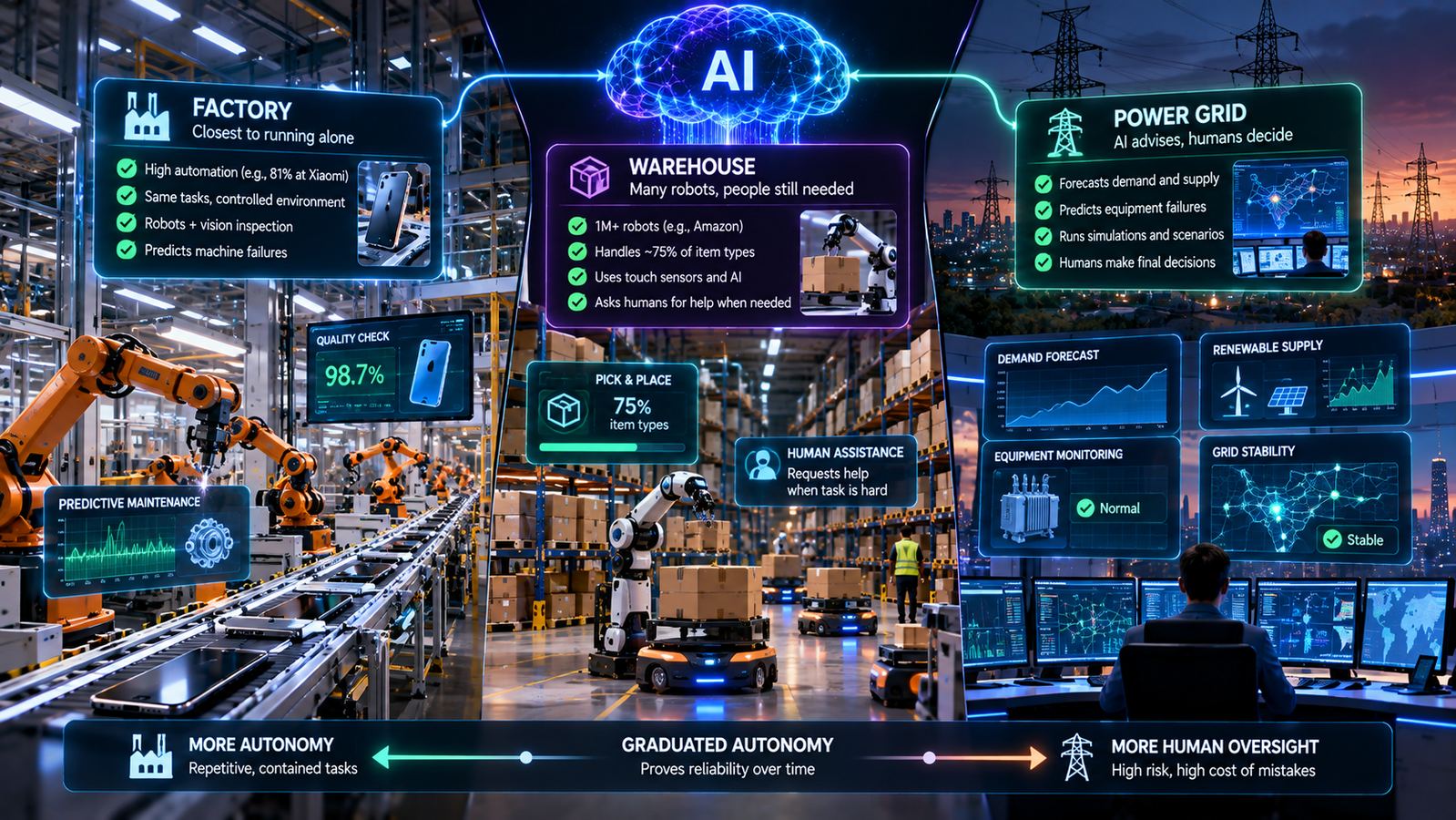
Can AI run a factory on its own? A warehouse? A power grid? The answer depends on one thing: what happens when the AI gets it wrong. Factories and warehouses already run with very few people. Power grids don't. That gap shows where AI autonomy is really going. It's not only about how smart the AI is. It's also about who is responsible when something breaks.
Factories: closest to running alone
Xiaomi's Changping plant near Beijing is the best-known example. It opened in July 2024 and cost about $330 million. It has 11 production lines and can make up to 10 million flagship phones a year. Xiaomi says the plant is 81% automated. A few people still work there, mostly to supervise and fix machines. Xiaomi's early marketing said the plant could make one phone every second. Reporters called that an exaggeration.
Japan's Fanuc has reportedly run a plant that builds robots with very little human help, sometimes for a month straight. Plants like these work because everything is tightly controlled. The same parts arrive. The same steps repeat. Cameras check the results, and software predicts when a machine is about to break. A messy, changing workplace is much harder, because robots have to handle surprises. Most factories today sit in the middle. They have a few fully automated areas, surrounded by work that still needs people.
Even fans are careful. Standard Bots, a robot maker, says fully "lights-out" factories won't be common by 2030. Most plants will just have more steps that run without people.
Warehouses: many robots, people still needed
Amazon says it has more than 1 million robots in its warehouses. Its newest robot, Vulcan, has force sensors that let it feel how hard it is gripping something. Amazon says it trained Vulcan on real touch data, not just simulations. The company also says Vulcan can handle about 75% of the item types it stores, at about the speed of a human. It asks a person for help when a task is too hard.
Those numbers come from Amazon. Its researchers describe the system in IEEE Transactions on Robotics papers, but that is still Amazon's own work, not independent testing. Vulcan works at sites in Spokane, in the US, and Hamburg, in Germany. Amazon plans to add more in 2026.
Amazon calls its robots helpers that take over heavy, tiring work. But Business Insider reported an internal Amazon document that called robots key to slowing the company's hiring over the next ten years. Both can be true, depending on the time frame. The 75% figure also means about a quarter of item types are still out of Vulcan's reach. And the fact that it asks for help shows the system still needs people as a backup.
Power grids: AI advises, humans decide
The grid is a different story. AI tools already forecast demand, predict wind and solar power, and flag equipment that might fail. But mostly, they give advice. Argonne National Laboratory's GridMind is an AI "co-pilot." It combines several specialized AI agents with standard power-system software. Operators can use it to test scenarios and get plain explanations. A June 2026 paper in Communications Engineering describes another group of AI agents that works under constant human supervision. Both are research projects. Neither runs a grid on its own.
Some vendors lay out a step-by-step plan. First, the AI suggests and humans approve. Next, the AI handles routine choices and flags strange ones. Only after that would it act alone, within set limits. That plan comes from a vendor blog. It hasn't been proven in real use.
The reason for caution is simple. A bad factory decision wastes a batch of phones. A bad grid decision can cut power to millions of people. The law reflects this. The EU AI Act treats AI in critical infrastructure as high-risk and requires human oversight. The rules were delayed, though. Under the EU's Digital Omnibus, which took effect in July 2026, the high-risk requirements now start on December 2, 2027. The oversight rules stayed.
What this could lead to
One pattern shows up in all three. The more repetitive and contained the job, the more freedom AI gets. The higher the cost of a mistake, the more humans stay in charge. The 2026 Singapore Consensus on AI safety research calls this "graduated autonomy." AI should earn more freedom by proving it is reliable, not get it by default.
In the near term, expect more factories with fewer people on the floor, more warehouse robots, and grid AI that stays in an advisory role. The longer term is speculation. Some vendors imagine self-optimizing grids by mid-century, with people only making big strategic calls. That forecast comes from companies that sell the technology, and nothing shows yet that it's realistic. The real question isn't whether AI can do the work. It's how much proof we should ask for before it works unsupervised.