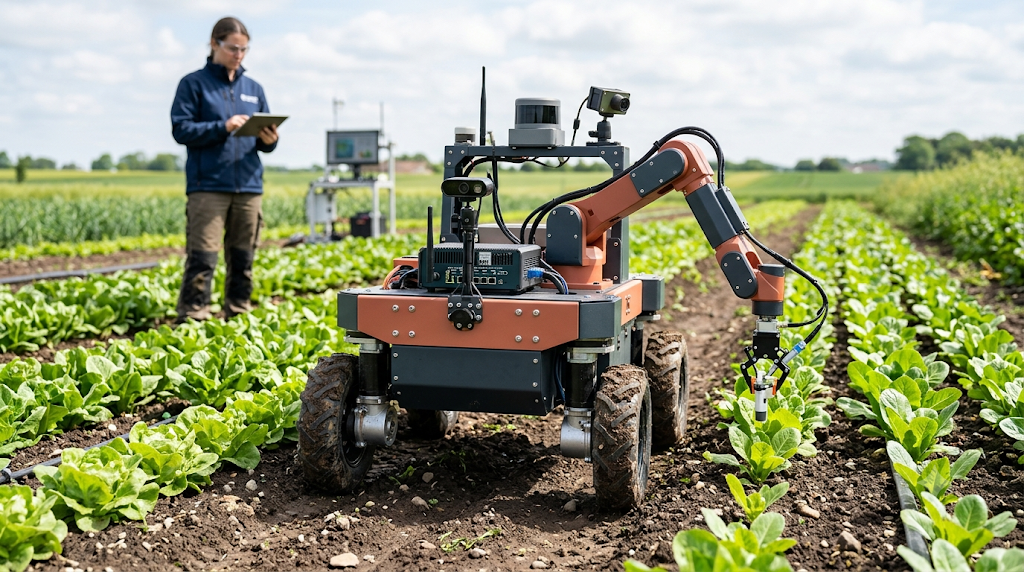
Imagine a robot moving between crop rows, planting seeds and checking whether the work is done properly. Researchers at Mississippi State University have developed a new farm robot called Agibot to explore these tasks.
Agibot is an open-source robot, which means other researchers can study its design and improve it. For now, it is only a research project and is not available for farmers to buy.
What Is Agibot?
On November 6, 2026, researchers shared a paper about Agibot on arXiv.
The research was carried out by Moeen Ul Islam and five other researchers. The paper has also been submitted to IEEE Transactions on AgriFood Electronics, but it has not yet completed formal expert review.
The team designed Agibot to be affordable and easy to modify.
Researchers can replace parts like cameras, sensors, computers and farming tools without building a completely new robot.
This makes it useful for testing different farming technologies.
How Does Agibot Work?
Agibot has four wheels, and each wheel can turn independently.
This movement system is called swerve drive. It helps the robot move between crop rows and change direction easily.
The robot follows four main steps: sense, plan, act and verify.
First, it uses sensors to understand its surroundings. Next, it decides what to do.
Then it performs a task, such as planting a seed or handling a plant.
Finally, it checks whether the task was completed correctly.
This is useful because the robot can notice when something goes wrong instead of simply moving to the next task.
Why Is Agibot Important?
Building agricultural robots can be expensive, especially for small research teams.
Since Agibot has an open design, researchers can use it as a starting point instead of developing everything themselves.
The team tested Agibot on tasks like following crop rows, moving between rows, finding targets, dropping seeds and handling plants.
The tests were carried out under different lighting and soil conditions.
According to the researchers, Agibot performed these tasks reliably and could check whether its actions were successful.
However, these are early research results.
What Are the Limitations?
Agibot is still a research prototype, not a finished farming machine.
Real farms have many challenges, including rain, mud, heat and uneven ground.
The robot must also work for long hours without breaking down.
Researchers still need to test its battery life, maintenance needs, durability and overall cost.
The current research does not prove that Agibot can work reliably across different farms, crops and seasons.
What Happens Next?
The researchers hope Agibot will help students and engineers develop better farming robots.
Other research teams can also use its open design to test new sensors, movement systems and farming tools.
The next step is testing Agibot on more crops and in different weather conditions.
Agibot may not be ready for everyday farming yet, but it could help researchers develop more useful and affordable agricultural robots in the future.