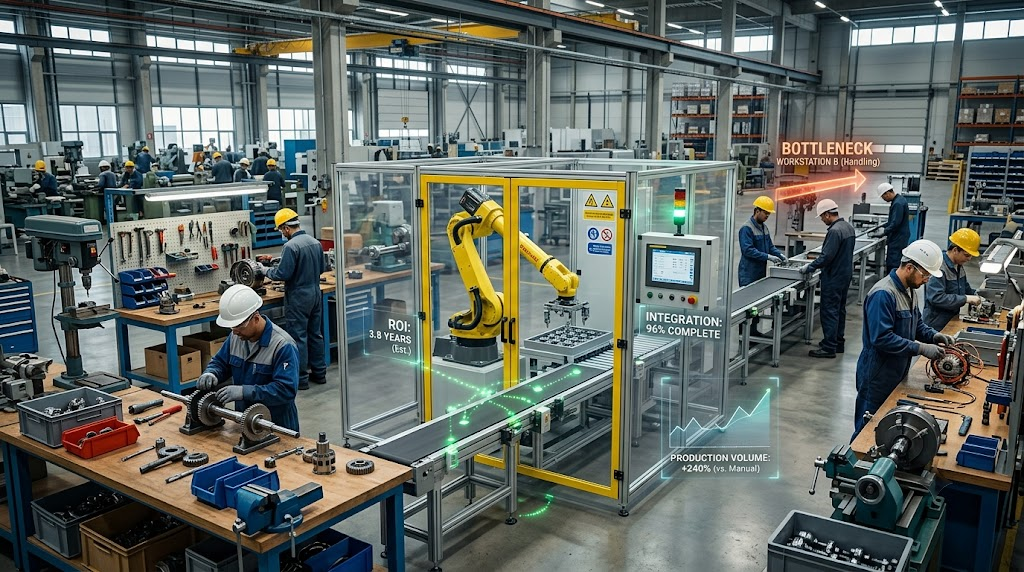
Walk into a modern factory and you might see robots working beside people while other parts of the same production line remain completely manual. That can look strange. If robots can automate one task, why not automate everything?
The answer usually comes down to economics and complexity.
Automation Has to Pay for Itself
A robot is an investment, not just a machine purchase. A factory has to consider the cost of the robot, tooling, safety equipment, programming, installation, maintenance and employee training.
The return can come from several places: higher production, shorter cycle times, fewer defects, less scrap, improved safety or better use of workers. The International Federation of Robotics identifies productivity, quality, flexibility, safety and cost reduction among the main reasons companies invest in robots.
But not every task produces enough benefit to justify automation.
A repetitive machine-loading operation performed thousands of times per shift may have a clear business case. A task performed only occasionally may not.
Integration Can Cost More Than Expected
The robot itself is only one piece of an automation project. It may need to communicate with machines, conveyors, sensors, vision systems and factory software. Engineers may also need to redesign fixtures, install safety systems and modify the production process.
IFR notes that installation and integration of a robot into a production cell can represent a substantial share of the overall cost.
This is why a factory may automate one well-defined bottleneck instead of rebuilding an entire production line.
A useful 2026 example is ABB's OmniVance collaborative surface-finishing cell. The company introduced it specifically to automate tasks such as sanding and polishing, with a focus on making deployment easier for small and medium-sized manufacturers. ABB says programming time can be reduced by up to 90%; this is a company claim, not an independent performance measurement.
Production Volume Changes the Calculation
Production volume is another major factor. If a factory produces thousands of identical parts, an automated system can repeat the same operation many times and spread its investment across a large number of products.
But high-mix, low-volume production is different. If products constantly change, automation may require frequent reprogramming, new fixtures or different tooling. The cost and engineering effort can make full automation difficult to justify.
That does not mean automation is impossible. It means manufacturers may choose flexible automation for a specific bottleneck first, then expand later if the results are positive.
Gradual Automation Reduces the Risk
For many factories, automation is therefore a process rather than a single massive project.
A manufacturer might first automate machine loading, material handling, welding, inspection or packaging. Once the system is operating reliably, the company can evaluate whether another process is worth automating.
This approach also creates practical experience. Workers learn how to operate and maintain the technology, engineers understand integration problems, and management gets real production data instead of relying entirely on estimates.
The trend is visible in 2026. ABB reported that 31% of respondents in its automotive manufacturing survey identified increased investment in automation and robotics as a key response to cost and competitive pressures.
India is seeing the same broader move toward automation. The challenge is not simply installing more robots; manufacturers have to decide where automation creates enough value to justify the investment.
The result is why a factory can contain one highly automated process next to several manual ones. The goal is not necessarily to automate everything. It is to automate the tasks where technology solves a real production problem and the economics make sense.